What is Paperless Picking: How Modern Warehouses Can Eliminate Errors, Increase Speed, and Scale Smarter
Ecommerce has permanently changed warehouse operations.
Two-day delivery is no longer impressive. Same-day fulfillment is increasingly expected. Customers track packages in real time and have little patience for errors. At the same time, order volumes are rising, SKU counts are expanding, and labor costs continue to climb.
In this environment, paper-based picking is not just inefficient, it’s a liability.
Printed pick lists, handwritten notes, manual verification, and delayed inventory updates create friction in a system that demands speed and precision. This is why modern fulfillment operations are transitioning to paperless picking, a digitally driven approach that transforms warehouse performance from the ground up.
This guide explores what paperless picking really is, how it works, where it creates competitive advantage, and how to implement it strategically using a modern warehouse management system like 3PLNext.
What Is Paperless Picking, and Why Does It Matter Now?
Paperless picking is a digitally enabled order fulfillment process that replaces printed pick slips with real-time task instructions delivered through connected devices.
Instead of relying on static paperwork, warehouse associates receive dynamic picking instructions through handheld scanners, mobile computers, voice headsets, or wearable devices. Each scan confirms the correct SKU and quantity, and every action update inventory instantly inside the warehouse management system (WMS).
The difference is subtle in appearance but massive in impact.
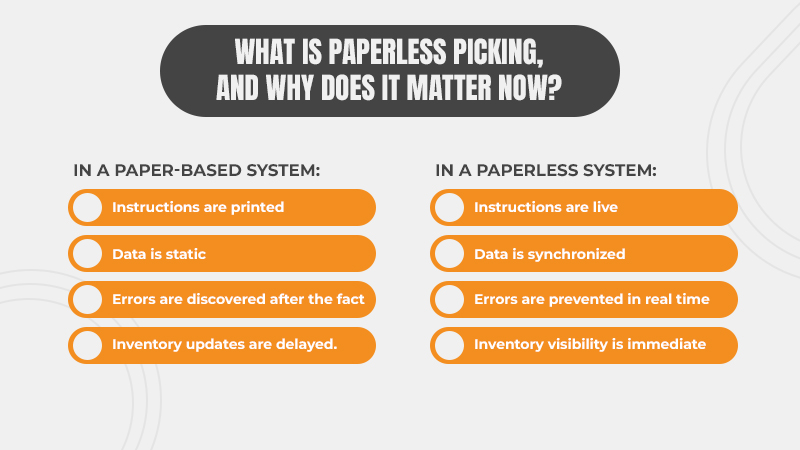
In a paper-based system:
- Instructions are printed.
- Data is static.
- Errors are discovered after the fact.
- Inventory updates are delayed.
In a paperless system:
- Instructions are live.
- Data is synchronized.
- Errors are prevented in real time.
- Inventory visibility is immediate.
In today’s fulfillment landscape, that difference defines whether an operation scales smoothly or struggles under pressure.
The Operational Advantages That Go Beyond “Saving Paper”
Many assume paperless picking is simply about eliminating printing costs. In reality, the true value lies much deeper.
Accuracy Becomes Built-In, Not Inspected Later
Human error is inevitable when relying on printed lists. A picker misreads a SKU. A quantity is interpreted incorrectly. A similar-looking product is grabbed by mistake.
Digital verification changes the equation.
Barcode scanning requires confirmation before an item is considered picked. The system validates SKU, quantity, and order association instantly. Errors are stopped at the source rather than discovered through returns and customer complaints.
For ecommerce brands and 3PLs, this translates directly into fewer returns, lower reverse logistics costs, and stronger customer trust.
Speed Improves Because Friction Disappears
Paper introduces small inefficiencies that compound over time:
- Walking back to retrieve misplaced documents
- Cross-checking handwritten notes
- Manual inventory adjustments
- Reprinting lost pick lists
Paperless picking eliminates these micro-delays.
Task assignments are generated automatically. Pick paths can be optimized by the WMS. Inventory counts update instantly. Workers focus purely on execution rather than administration.
The result is measurable improvement in order cycle times, especially critical during seasonal spikes and promotional events.
Inventory Becomes a Live Asset, not a Guess
Real-time data is the backbone of modern fulfillment.
With every scan updating the system immediately, inventory accuracy improves dramatically. Overselling becomes rare. Stock discrepancies are reduced. Replenishment decisions are based on live information instead of end-of-day reconciliations.
For multi-client 3PL environments, this visibility is even more critical. Clients demand accurate stock reporting, performance analytics, and transparency. Paperless workflows make this possible without manual reporting burdens.
Cost Savings Compound Over Time
While eliminating paper and printing is a direct saving, the larger financial impact comes from operational efficiency:
- Reduced labor hours per order
- Fewer mis-picks and costly reshipments
- Lower customer service intervention
- Decreased return processing costs
When scaled across thousands of orders per day, even small efficiency gains create substantial ROI.
The Technologies That Power Paperless Picking
Paperless picking is not a single tool, it’s an ecosystem of integrated technologies.
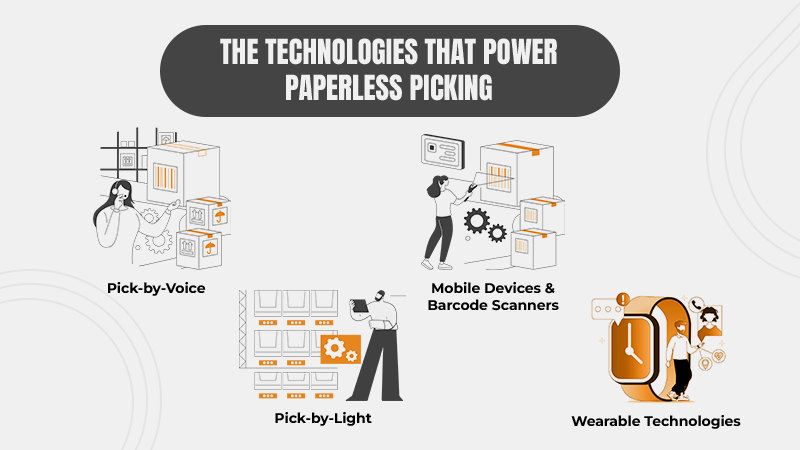
Pick-by-Voice
Voice-directed systems guide workers through spoken instructions delivered via headset. Pickers confirm tasks verbally, keeping their hands and eyes focused on physical movement.
This method is particularly effective in high-volume environments where speed and safety must coexist.
Pick-by-Light
LED indicators illuminate the correct bin location and display the quantity required. Pickers move quickly through high-density SKU environments with minimal confusion.
Though hardware investment is higher, pick-by-light excels in rapid batch picking scenarios.
Mobile Devices & Barcode Scanners
For many warehouses, handheld scanners or rugged mobile devices offer the most accessible entry into paperless workflows.
These devices:
- Display digital pick lists
- Validate SKUs through scanning
- Update inventory instantly
- Sync with the WMS in real time
Cloud-based platforms have made deployment simpler and more scalable than ever before.
Wearable Technologies
Smart glasses and wrist-mounted scanners represent the next evolution of hands-free picking. Instructions appear directly in the worker’s field of vision, reducing unnecessary movement and increasing efficiency.
While still gaining adoption, wearable solutions demonstrate how digital picking continues to evolve.
Integration: The Foundation of True Paperless Efficiency
Technology alone is not enough.
Paperless picking must integrate seamlessly with:
- Warehouse Management Systems (WMS)
- ERP platforms
- Ecommerce stores
- Shipping carriers
Without real-time data synchronization, digital tools become fragmented.
A unified system ensures:
- Orders flow automatically from storefront to warehouse
- Inventory updates instantly across channels
- Tracking details sync back to customers
- Performance metrics are centrally visible
This is where modern WMS platforms play a critical role.
Implementing Paperless Picking: A Strategic Approach
Transitioning from paper to digital is not simply a software upgrade, it’s an operational transformation.
Successful implementation requires structure.
First, evaluate your current workflows. Identify bottlenecks, error hotspots, and manual touchpoints. Establish baseline metrics so improvement can be measured.
Second, select technology aligned with your warehouse complexity and growth plans. Scalability matters more than short-term convenience.
Third, ensure infrastructure readiness. Strong WiFi coverage, device management protocols, and API integration capabilities are essential.
Fourth, prioritize change management. Training programs, internal champions, and phased rollouts significantly reduce resistance and disruption.
Finally, start small. Pilot in one section of the warehouse, refine processes, then expand systematically.
Digital transformation succeeds when executed deliberately.
Strategic Impact: Beyond Operational Efficiency
Paperless picking strengthens more than productivity.
It enhances sustainability efforts by reducing paper waste. It supports ESG positioning for environmentally conscious brands. It enables better data analytics for forecasting and procurement decisions. It standardizes workflows across multiple warehouse locations.
For 3PL providers, it improves client reporting, billing accuracy, and onboarding speed.
Ultimately, paperless picking improves the one metric that matters most: customer experience.
Accurate, fast, and transparent fulfillment builds trust, and trust drives repeat business.
How 3PLNext Enables Modern Paperless Picking
At 3PLNext, paperless picking is embedded within the core architecture of the platform.
Our cloud-based WMS supports real-time barcode validation, automated task assignment, and seamless multi-warehouse visibility. Orders flow directly from ecommerce platforms into the system without manual entry. Inventory updates instantly across locations. Performance data is accessible through centralized dashboards.
For 3PL providers managing multiple clients, 3PLNext standardizes digital workflows while maintaining client-level visibility and reporting.
By combining robust integration capabilities, live inventory synchronization, and barcode-driven verification, 3PLNext transforms paperless picking from a feature into a strategic advantage.
The Bottom Line
Paper-based picking belongs to a slower era of logistics.
Today’s warehouses require speed, visibility, scalability, and data precision. Paperless picking delivers all four.
It reduces errors before they happen.
It accelerates fulfillment without sacrificing accuracy.
It strengthens sustainability initiatives.
It enables scalable growth across locations and clients.
Most importantly, it positions your fulfillment operation to compete, and win in an increasingly demanding ecommerce environment.


Leave a Reply