How to Choose a Warehouse Management System: A Practical Evaluation Checklist
Three warehouse management systems can all claim to support receiving, inventory, picking, packing, and shipping. Yet they may handle your warehouse very differently.
One might process standard ecommerce orders well but struggle with wholesale case picking. Another might offer detailed inventory controls while requiring manual work to apply client billing rules. A third might look affordable until integrations, additional warehouses, and implementation services enter the quotation.
If you are deciding how to choose a warehouse management system, the useful question is whether the software can run your specific operation, at the required scale, with costs and responsibilities you understand.
This guide turns that question into a practical WMS evaluation checklist. You will learn how to define requirements, test vendors against the same scenarios, compare total costs, and document a decision your warehouse team can support.
How Do You Choose a Warehouse Management System?
Choose a warehouse management system by documenting your operating requirements, identifying essential capabilities, testing shortlisted platforms with representative workflows, and comparing implementation, support, reliability, and total cost. Require evidence for critical functions and resolve material gaps before selecting a vendor.
The process should involve operations, IT or systems support, finance, and the employees who will use the software. For a 3PL, include the people responsible for client onboarding, account management, and billing. Each group sees requirements that a product demonstration alone can miss.
Start With Your Warehouse’s Operating Model
Before comparing products, prepare a concise profile of your warehouse. Include active SKUs, storage locations, average and peak order volumes, order lines, units, warehouses, shifts, concurrent users, and connected systems.
Describe the work as well as the volume. Two facilities shipping 2,000 orders per day can have very different requirements if one handles single-item parcels and the other processes mixed-case wholesale orders.
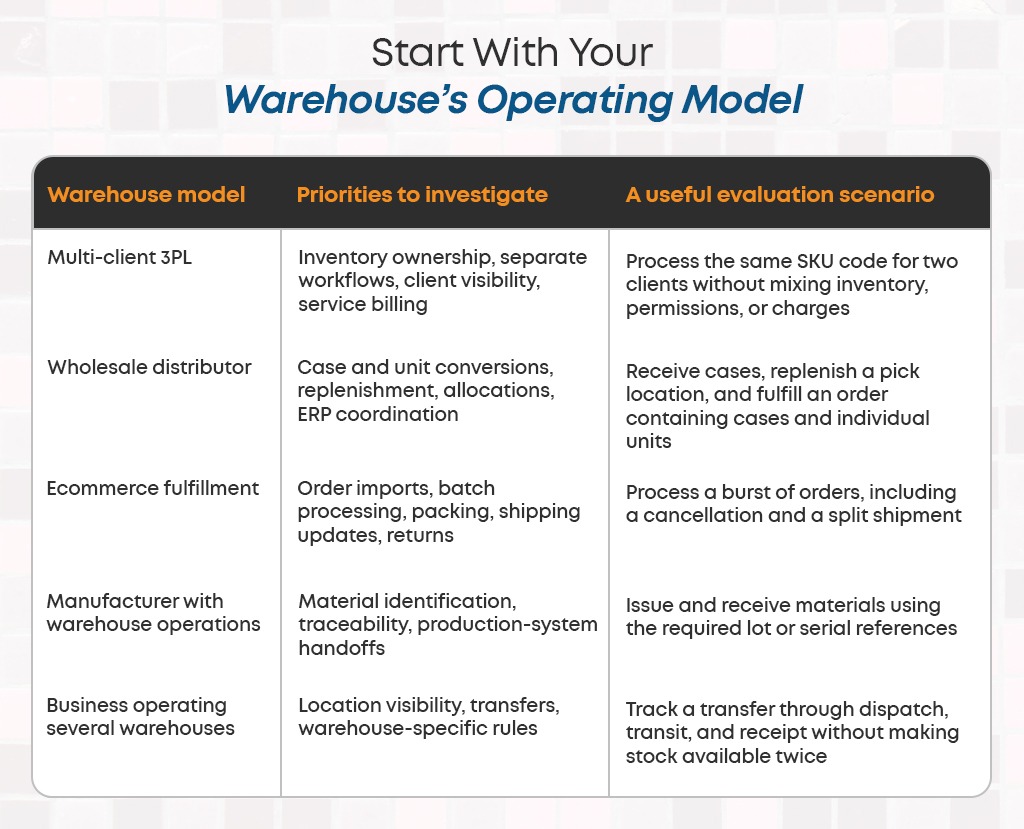
These are starting points, not rigid categories. A 3PL may fulfill both wholesale and ecommerce orders. A distributor may sell online and through branches. Your evaluation should reflect the combinations your warehouse actually handles.
Also establish whether the requirement is a new WMS, a stronger warehouse module in an existing system, or an improvement to current processes. Ask shortlisted providers to explain which responsibilities remain with your ERP, order management, accounting, or shipping systems.
Turn Problems into Testable WMS Requirements
“Improve inventory accuracy” is a goal. It is not yet a requirement that a vendor can demonstrate.
A more useful requirement might read: “A picker must confirm the source location and item before completing a pick, and a mismatch must prevent completion or follow an approved exception process.”
Connect each requirement to the problem it addresses and the evidence needed to accept it.
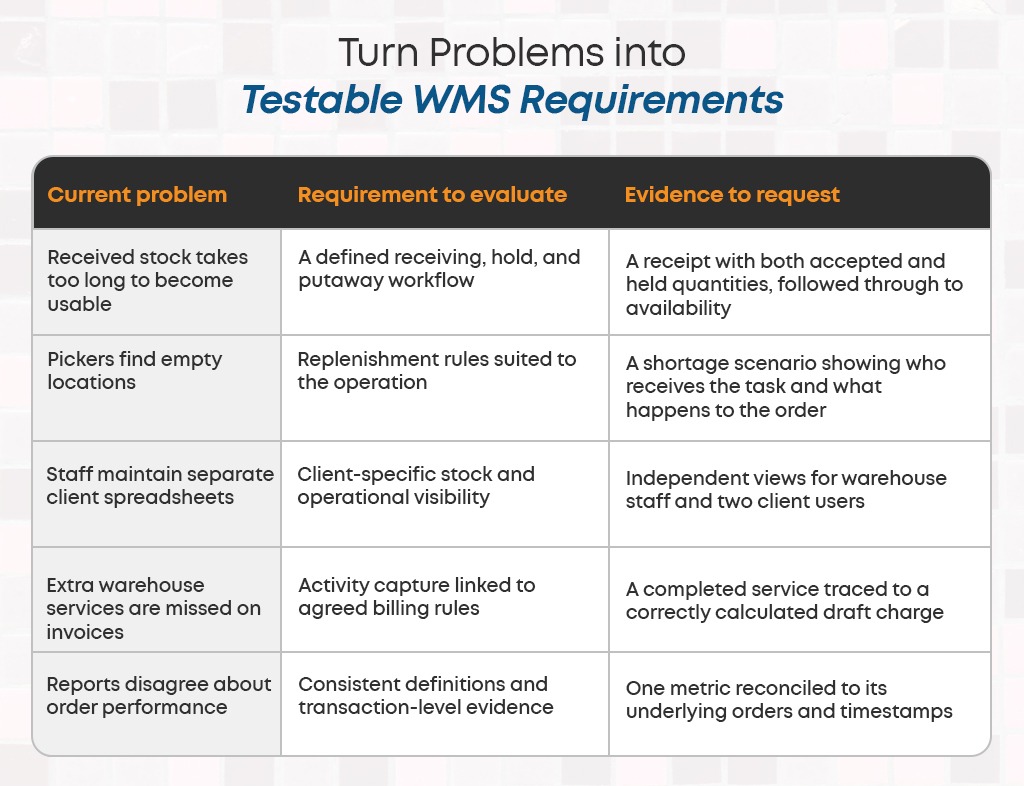
Logiwa’s requirements guidance begins with identifying warehouse problems and assessing the capabilities needed to address them. Use that principle to write requirements in operational language before translating them into a feature list.
Source: Logiwa’s WMS requirements guide.
Classify requirements as essential for launch, important for a defined later phase, or optional. Give future requirements a business reason and likely timing. Treating every possible feature as essential makes comparison harder and can expand cost without improving the initial operation.
Set baseline measures for the problems you intend to solve. The definitions in 15 warehouse KPIs every 3PL should track can help structure that measurement. Targets should reflect your order mix and starting position.
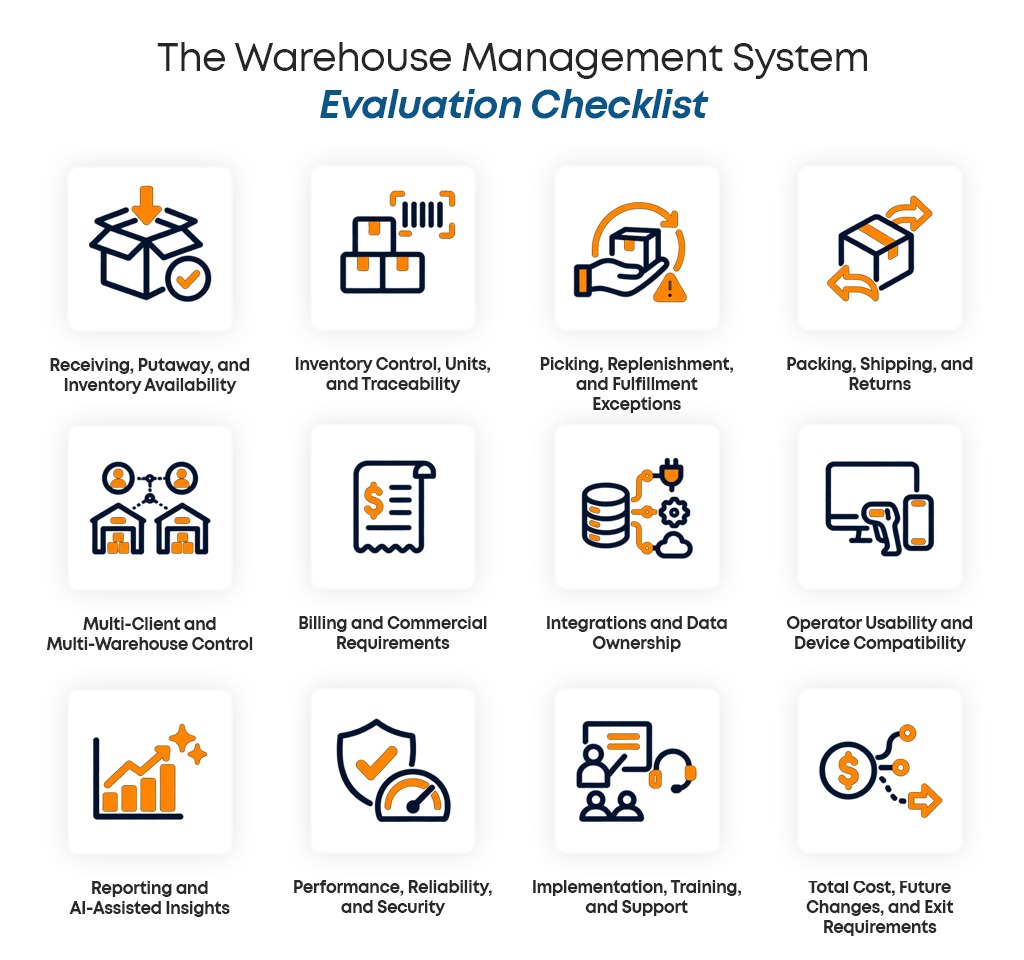
The Warehouse Management System Evaluation Checklist
- Receiving, Putaway, and Inventory Availability
Ask the vendor to receive a shipment with a quantity difference, a damaged item, and a product that requires additional checking. Follow those quantities through the system.
Can the team distinguish expected, received, accepted, held, and available stock? Who can resolve a discrepancy? Can operators capture the required information on their working devices without returning to a desk?
For putaway, test how the system handles an unavailable destination, a full location, and an item with storage restrictions. Establish whether the software directs the activity, merely records it, or relies on a separate process.
Acceptance question: Can your team explain where every received quantity is and whether it can be allocated to an order?
- Inventory Control, Units, and Traceability
Evaluate inventory at the level your operation needs: client or owner, warehouse, location, SKU, status, unit of measure, and any required lot, serial, or expiry attributes.
Use real packaging relationships. If a case contains 24 units, test a receipt in cases and an order in individual units. Review the resulting balances and conversions rather than assuming a successful scan means the quantity is correct.
Where traceability matters, follow a lot or individual serial through receipt, movement, shipment, and return. Lot tracking and serial number tracking answer different questions; confirm the required level of detail for each product.
Test a stock count while relevant work is active. Ask how the WMS handles movements during counting, count approvals, and adjustment history. A count that balances today should not obscure how the difference arose.
Acceptance question: Can you reconcile stock and its history without losing ownership, status, unit, or traceability information?
- Picking, Replenishment, and Fulfillment Exceptions
Evaluate the picking methods that fit your workload, such as individual orders, batch picking, zone picking, or waves. Ask the vendor to explain when each method is appropriate and which setup it requires.
Include a location shortage, a replenishment needs, an urgent order, and an order held for clarification. Observe what the operator sees and how the supervisor intervenes.
If you assemble kits, distinguish between building finished kits into inventory and collecting components during fulfillment. Confirm how component availability, substitutions, and stock deductions work for your chosen method.
Avoid judging productivity from one quick demonstration. Measure representative tasks with suitable data and equipment, including the effort required to handle exceptions.
Acceptance question: Can the system keep work moving when the physical situation differs from the planned task?
- Packing, Shipping, and Returns
Ask an operator to pack a representative order using your verification rules and documents. Check item confirmation, carton contents, packaging instructions, label output, and shipment status.
Test the devices and label formats you expect to use. Verify what happens if a label must be reprinted, a shipment is canceled, or a carrier request fails. Reprinting a document should not accidentally create another shipment or charge.
For returns, follow an item from receipt through inspection and disposition. Confirm how saleable, damaged, and held quantities are treated, and which system owns any customer refund or credit decision.
Acceptance question: Do physical dispatch, system status, inventory movements, and downstream notifications remain consistent?
- Multi-Client and Multi-Warehouse Control
For 3PL warehouse software, separate inventory ownership is a core evaluation requirement. Test two clients with the same SKU code, different handling rules, and different user permissions.
Inspect client views, reports, exports, and relevant interfaces. Confirm that an account can access its own information and that warehouse users have the scope appropriate to their roles.
When evaluating multiple warehouses, test a transfer rather than only looking at consolidated stock totals. Confirm treatment of stock that has left one site but has not arrived at the next.
Ask how a new client or warehouse is configured. Record what can be reused, what must be reviewed, and what requires vendor assistance. Multi-client management should be evaluated through these operational details.
Acceptance question: Can you add complexity while keeping ownership, access, and transactions clearly separated?
- Billing and Commercial Requirements
For a 3PL, test a client agreement with its actual charging units and service inclusions. Include receiving, storage, fulfillment, and any relevant additional service.
Check the calculation at a billing boundary. How are rate changes, minimums, partial periods, discounts, and corrected transactions treated? Can finance explain the quantity and activity behind a charge?
If the warehouse is a distributor rather than a service provider, determine which commercial functions belong in the ERP. Do not assume that warehouse service billing replaces sales invoicing, credit control, or customer pricing.
3PL billing software is valuable when its rules match the agreements you need to administer. The evaluation should establish those rules before relying on projected revenue improvements.
Acceptance question: Does completed warehouse work produce the intended commercial result without repeated spreadsheet reconstruction?
- Integrations and Data Ownership
An integration logo does not establish the scope of a connection. Ask which objects and events are supported, how often information moves, what configuration is required, and who maintains the connection.
Map ownership for products, orders, inventory availability, shipments, invoices, and corrections. Include your ERP, ecommerce platforms, marketplaces, carriers, accounting tools, and any automation systems that are in scope.
Test an unknown SKU, a duplicate order transmission, a cancellation after work starts, and a failed message followed by a retry. Check whether failures are visible and whether recovery produces duplicates.
For each required connection, obtain a written scope covering dependencies, setup fees, recurring fees, limits, and support ownership. Review 3PLNext’s integration options against these same questions when evaluating the platform.
Acceptance question: Can both teams trace a transaction across systems and resolve a failure without guessing which system is correct?
- Operator Usability and Device Compatibility
Let representative warehouse employees try the workflows after brief instruction. Ask them to receive, move, pick, and correct a transaction using the intended devices.
Observe unnecessary typing, repeated screens, confusing messages, and steps that require a supervisor. A dashboard can look clear while a handheld process remains awkward during a busy shift.
Confirm supported scanners, operating systems, browsers, printers, label formats, and network requirements. Evaluate connection-loss behavior directly; do not assume mobile access includes offline processing.
Infor’s overview identifies user-friendly design, flexible configuration, and integration capabilities as relevant WMS selection characteristics. Your evaluation should translate those broad qualities into tasks employees can perform.
Source: Infor’s WMS overview.
Acceptance question: Can trained staff complete common work and understand exceptions with a reasonable amount of assistance?
- Reporting and AI-Assisted Insights
Start with the decisions managers need to make. Ask for a backlog view, an inventory discrepancy report, and a measure such as on-time dispatch with a clear definition.
Change the date range, warehouse, and client. Follow a result back to the relevant records. Confirm who can configure reports and whether additional reporting tools or fees are needed.
When a vendor offers an AI assistant, test a question with a known answer. Include an ambiguous request and a user with restricted access. Evaluate the answer’s scope, freshness, supporting records, and handling of uncertainty.
Separate asking questions about existing data from predicting future events or changing warehouse tasks automatically. Each capability needs its own evidence. For example, 3PLNext’s AI Assistant is presented as a way to ask questions about warehouse data; assess that function on the questions your team needs answered.
Acceptance question: Can a manager understand, verify, and act on the output without misinterpreting its scope?
- Performance, Reliability, and Security
Provide a realistic workload profile. Include peak order arrivals, concurrent users, active SKUs, order complexity, interfaces, and reporting activity. An annual order total alone says little about a short, intense fulfillment window.
Ask for relevant performance evidence or an agreed test. Measure the activities that matter to operators, such as order import, allocation, scan confirmation, and label production. Record delays and failed transactions as well as averages.
Review service availability commitments, maintenance arrangements, backup and recovery responsibilities, and incident escalation. Ask the provider to explain the expected restoration time and acceptable data-loss window in operational terms.
For security, review access controls, authentication options, activity history, data hosting, and the scope of any assurance documentation offered. Establish which controls the provider operates and which your organization must configure.
Acceptance question: Is there credible evidence and a workable responsibility model for running your warehouse during peak demand and handling disruption?
- Implementation, Training, and Support
Request an implementation plan tied to your requirements. It should identify configuration, data preparation, connections, testing, training, inventory reconciliation, cutover, and post-launch support.
Distinguish account setup from operational readiness. Clean data, working connections, trained employees, and an agreed stock transition all affect the schedule.
Ask who performs each task, who approves completion, and which assumptions affect the quote. Identify the people your own business must make available. Their time is part of the project even when it does not appear on the vendor’s invoice.
For support, confirm hours, time zones, channels, severity definitions, escalation, and coverage during your busiest periods. A response target does not necessarily mean the issue will be resolved within that time.
Acceptance question: Can both parties explain how the warehouse will reach go-live and who owns problems after launch?
- Total Cost, Future Changes, and Exit Requirements
Compare quotations using the same operating assumptions: warehouses, users, clients, order volumes, modules, integrations, environments, and support level.
Identify what changes the price. These may include transaction tiers, extra locations, connector fees, additional storage, advanced reporting, implementation changes, or premium support.
Ask how routine changes are handled after launch. Which rules can your administrator change? Which require consulting? How are extensions tested when the platform is updated?
Also confirm how data can be exported, which historical records are available, and what assistance or charges apply when leaving the service. Make these requirements part of the evaluation while you still have time to compare options.
Acceptance question: Can you estimate the cost of operating, growing, changing, and eventually transitioning away from the system?
Cloud WMS, On-Premises, or an ERP Warehouse Module?
These choices describe different aspects of the solution. Cloud and on-premises concern deployment and operating responsibilities. An ERP warehouse module describes how warehouse functionality fits within a broader business system; it may itself be cloud-based or locally hosted.
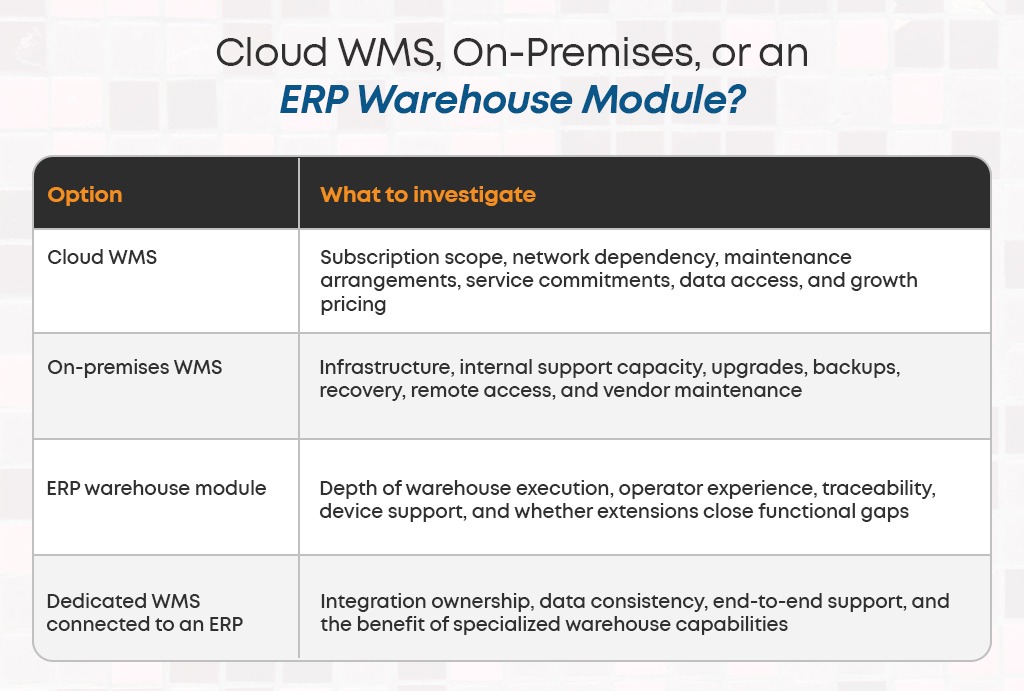
A cloud-based WMS still requires implementation, reliable site connectivity, suitable devices, and clear administration. A locally hosted system still needs maintained software and a tested recovery plan. Compare the complete operating arrangement and workflow fit.
Run a Demo That Produces Comparable Evidence
Send each shortlisted vendor the same sample data, workflows, and expected outcomes before the demonstration. Include ordinary work and a small number of exceptions that expose your most important requirements.
Mecalux’s selection guidance recommends documenting operating specifications and requesting live software demonstrations. A practical extension is to give every vendor the same demonstration brief so the results can be compared.
Source: Mecalux’s WMS selection guide.
Use this compact demonstration script:
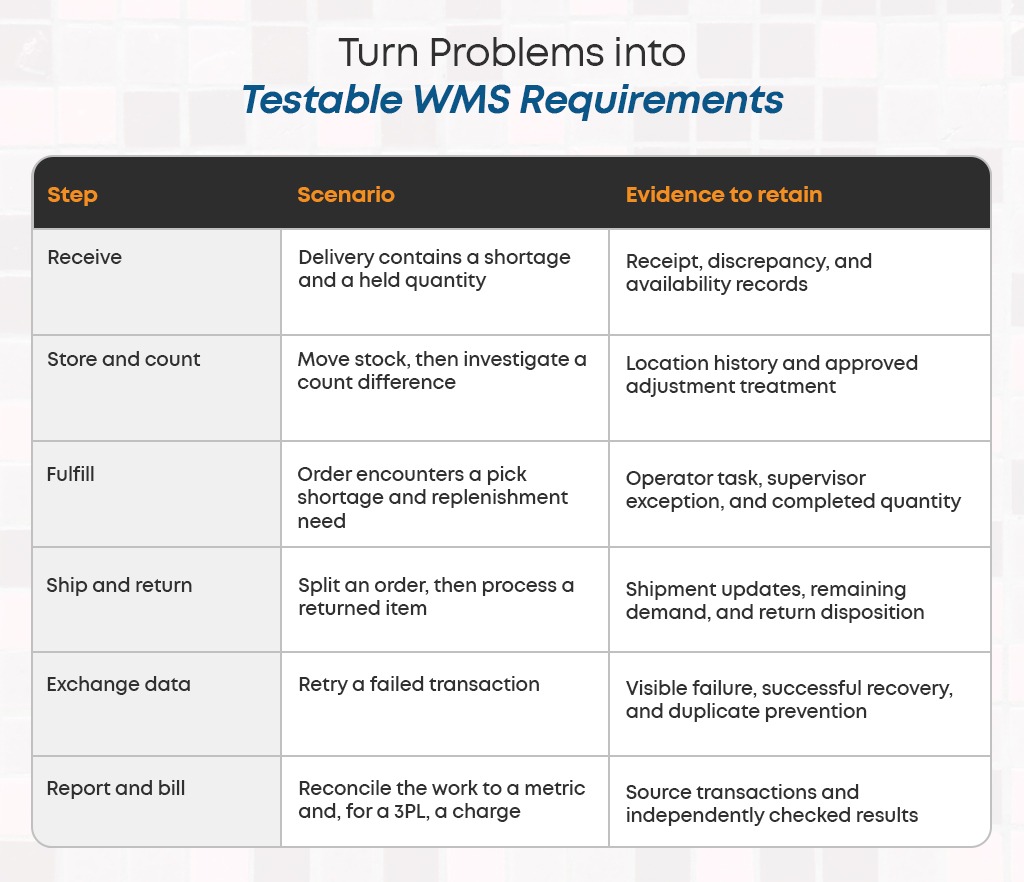
For every requirement, record whether the result was observed, only described, or still untested. Record delivery method separately: standard functionality, configuration, paid module, partner integration, or custom development.
If a feature is on the roadmap, identify the dependency and treat it as unavailable for the current decision until delivered and verified. “Supported” should lead to a clear explanation of how, when, by whom, and at what cost.
Use a Weighted WMS Vendor Scorecard
Apply essential requirements first. A vendor that fails a mandatory ownership, traceability, integration, or operating requirement should remain on hold until the gap is resolved, regardless of its overall score.
Then score the options that remain viable. The weights below are an illustrative starting point, not an industry standard. Adjust them before viewing vendor results and apply the same weights consistently.
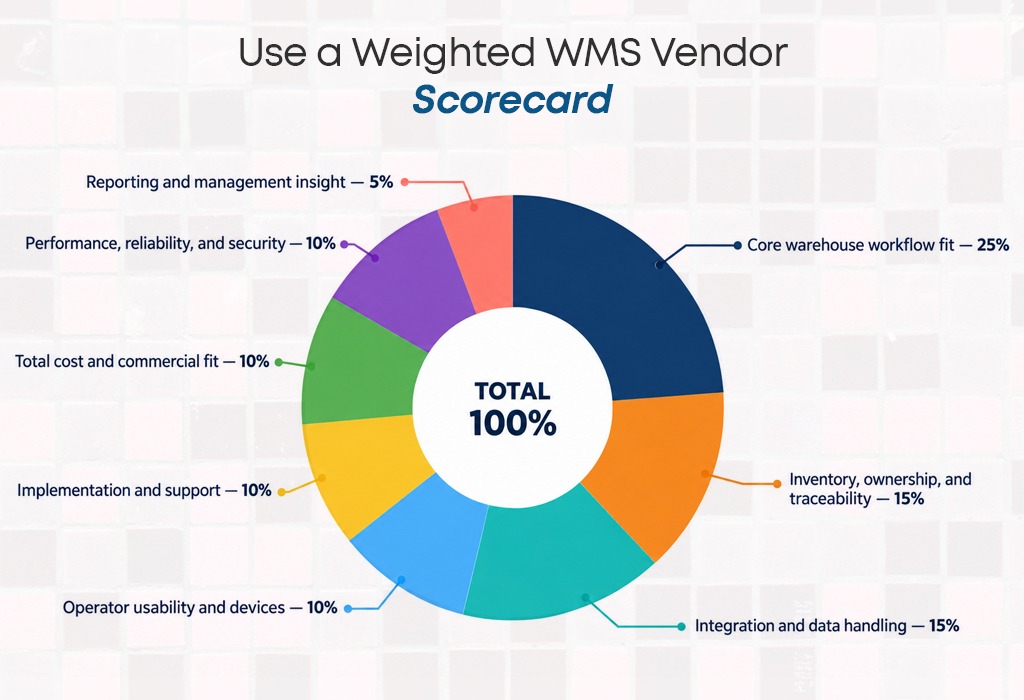
Define the rating scale before scoring:
| Rating | Meaning |
| 0 | Requirement is not met |
| 1 | Major gaps remain; the proposed approach is unacceptable without substantial change |
| 2 | Partial fit; significant additional work or manual processing is required |
| 3 | Meets the defined requirement with acceptable, documented conditions |
| 4 | Meets the requirement well and offers relevant, verified operational advantages |
| 5 | Demonstrably strong fit with additional benefits that matter to the stated goals |
| U | Untested or unresolved; insufficient evidence to assign a final rating |
Weighted points = Category weight × Rating ÷ 5
A rating of 4 in a category weighted at 15% contributes 12 points to a total out of 100. Define and weight sub requirements within broad categories so teams do not average unrelated opinions casually.
Keep untested requirements visible and finish the necessary validation before assigning a final score. Have stakeholders score their areas independently, then reconcile differences using the evidence.
Review the result for sensitivity. If a modest, reasonable change in priorities reverses the ranking, the finalists may be closely matched. Resolve the decisive tradeoffs rather than treating a small numerical lead as certainty.
Compare Three-Year WMS Costs on the Same Basis
Use a cost model that includes both vendor charges and your own implementation effort. A useful planning formula is:
Three-year estimated cost = Upfront setup and transition costs + 36 months of recurring costs + Other planned costs during the period
For annual fees, usage pricing, or expected growth, model those amounts explicitly. Do not multiply a first-month quote by 36 if your expected usage changes materially.
The hypothetical example below assumes fixed scope, flat monthly charges, and no inflation over three years. Amounts are illustrative USD planning figures, not market benchmarks or vendor quotations.
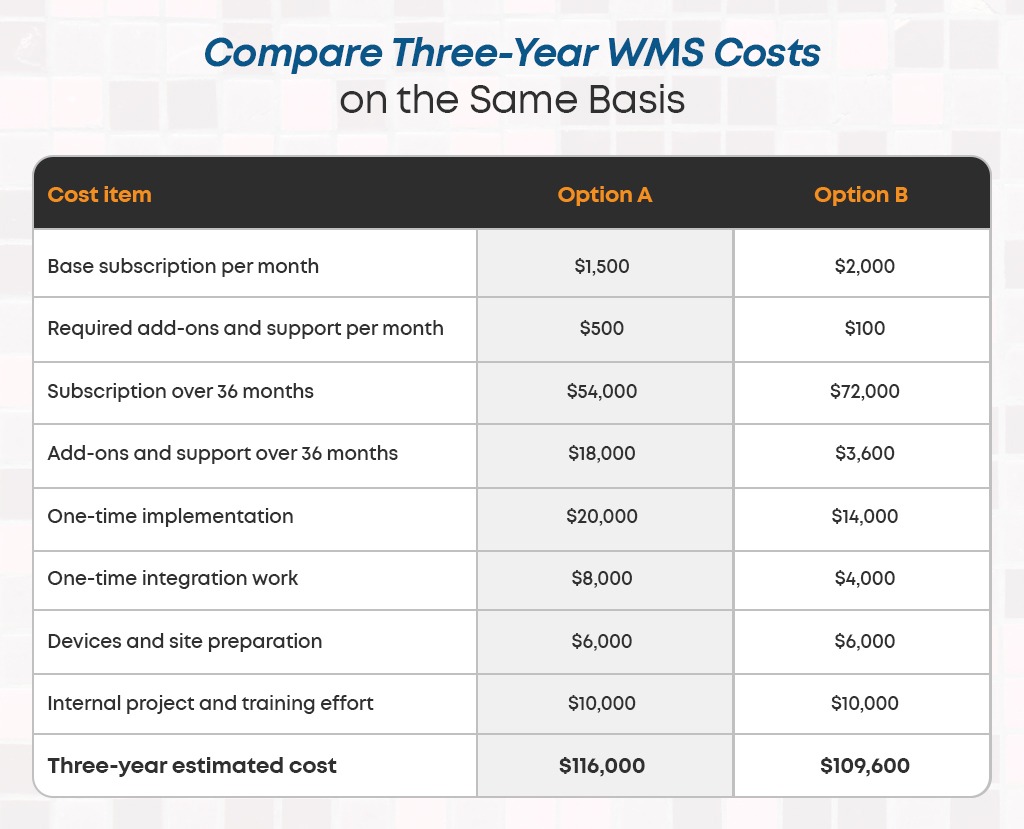
The monthly figures are inputs; they are not added again to the total. In this example, the lower base subscription leads to the higher overall estimate because other costs outweigh the difference.
Add any applicable taxes, travel, legacy-system overlap, growth tiers, planned changes, and transition assistance to your actual model. Keep uncertain amounts visible as ranges or separate scenarios. Identify costs already included elsewhere to avoid double counting.
Evaluate expected benefits separately. Faster processing can create capacity without immediately reducing payroll. Recovered 3PL charges should be supported by an audit of eligible missed work. Use measurable assumptions and avoid counting the same improvement twice under labor savings and capacity gains.
Resolve the Remaining Gaps Before Choosing a Vendor
The final decision should identify the selected option, why it fits, the evidence reviewed, unresolved limitations, implementation responsibilities, and expected costs.
Give every accepted gap an owner and a plan. If a required connection needs development, document scope, completion criteria, testing, charges, and its effect on launch. A vague promise to “work it out during implementation” leaves the most difficult part of the decision unfinished.
Request relevant customer references where available and ask specific questions about configuration, training, support, and changes after launch. Use reference feedback as additional evidence while retaining your own workflow tests.
Before committing, confirm that the written proposal reflects the modules, connections, environments, services, and assumptions used in the evaluation. Have the responsible internal owners review commercial and service terms through your normal procurement process.
Evaluating 3PLNext Against Your Requirements
3PLNext provides cloud-based warehouse management capabilities covering inventory visibility, warehouse operations, multi-location management, reporting, and mobile workflows. Its published overview also describes implementation support and user training. Explore the 3PLNext platform overview.
Evaluate it using the same requirements and evidence standard you apply to other shortlisted systems. For a 3PL, bring a client agreement and representative fulfillment tasks. For a distributor, include case-and-unit handling, replenishment, and ERP handoffs.
The best outcome is a clear understanding of what works out of the box, what requires configuration, and what needs additional implementation or integration work.
Request a 3PLNext demo and bring your warehouse requirements so the team can demonstrate the workflows that matter to your operation.
Frequently Asked Questions
What is the most important factor when choosing a WMS?
Start with verified fit for your essential workflows and inventory controls. Cost, usability, reliability, and support also matter, but a strong overall score cannot compensate for a system that fails a requirement needed to operate the warehouse.
What should a warehouse management system requirements checklist include?
Include receiving, inventory control, traceability, picking, packing, shipping, returns, integrations, user access, reporting, devices, performance, implementation, support, and cost. Add client ownership and service billing for a 3PL. Define the expected outcome and evidence for each important requirement.
How many WMS vendors should you evaluate?
Use a manageable shortlist that your team can test consistently. Three credible candidates can provide a useful comparison, but the right number depends on the operation and available options. Remove clear mismatches early so detailed evaluation time goes to viable systems.
Can an ERP replace a dedicated WMS?
An ERP warehouse module may meet an operation’s needs if it provides the required execution, controls, usability, and device support. More complex requirements may justify a dedicated WMS connected to the ERP. Test the actual workflows before deciding based on product category alone.
How much does a warehouse management system cost?
Cost depends on scope, deployment, users, locations, transaction volumes, integrations, implementation, and support. Request comparable quotations and estimate the full cost over a defined period. The illustrative three-year model in this guide is a calculation example, not a typical price range.
Should you choose a WMS because it offers AI?
Evaluate AI against a specific job, such as answering an operational question or recommending an action. Check accuracy, permissions, supporting data, and limitations. Core warehouse execution still needs to pass its own tests, regardless of the quality of an AI demonstration.
How do you know a WMS is ready for implementation?
Critical requirements should be validated, material gaps resolved or formally planned, and implementation scope, responsibilities, costs, and acceptance criteria agreed. Operational go-live requires further configuration, data preparation, training, reconciliation, and testing within the implementation project.



Leave a Reply