
How 3PL Warehouses Lose Revenue Through Manual Billing and How to Stop It
How 3PL Warehouses Lose Revenue Through Manual Billing and How to Stop It
A warehouse team spends an afternoon relabeling cartons for a client. The shipment leaves on time, the inventory records are updated, and the client is satisfied. Weeks later, the invoice includes fulfillment and storage, but the relabeling work is missing.
The warehouse paid for the labor and delivered the service. It simply never charged the agreed fee.
That is how manual 3PL billing can erode revenue: a completed task, an incomplete record, and a charge that never reaches an invoice. These gaps can remain hidden even when order volumes are growing and the operation looks busy.
Preventing 3PL revenue leakage requires a reliable connection between the client agreement, the work performed, and the amount billed. This guide explains where that connection breaks, how to measure the missing charges, and how to build a billing process that stands up to both internal review and client questions.
What Is 3PL Revenue Leakage?
3PL revenue leakage occurs when a warehouse fails to bill the full agreed amount for eligible services it has delivered. Examples include omitted handling fees, undercounted storage, expired discounts that remain active, and completed special projects that never appear on an invoice.
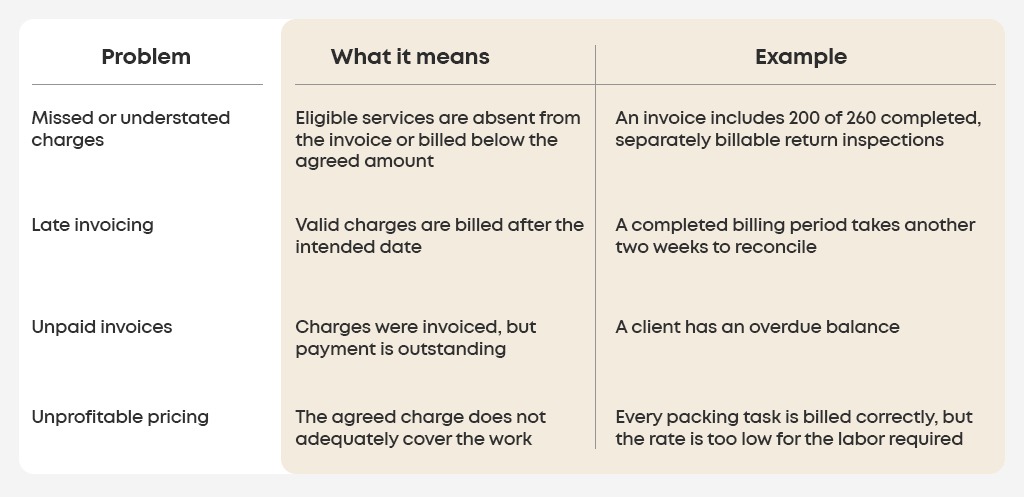
For a practical billing audit, distinguish four different problems:
These problems need different remedies. Capturing more warehouse activity can expose missing charges. It does not, by itself, fix collection problems or make an unprofitable contract profitable.
A late invoice can delay payment without permanently losing revenue. An approved discount is also different from an accidental undercharge. Keep those distinctions visible when measuring the benefits of billing automation.
Why Manual 3PL Billing Becomes Difficult to Control
Manual billing can be manageable with a small number of clients and simple agreements. The challenge grows when clients have different charging units, service inclusions, storage methods, and billing periods.
One account might pay for receiving by pallet, another by carton. One fulfillment fee might include the first picked item, while another includes three. A third client might reserve warehouse space regardless of how much inventory occupies it.
If employees must interpret these differences repeatedly, accuracy depends on both the records available and the person preparing the invoice.
The broader industry recognizes the connection between warehouse execution and billing. Infor identifies recording operational activities and their associated charges as a way a WMS can support accurate, transparent 3PL invoicing. That supports treating billing as part of warehouse process design.
Source: Infor’s analysis of WMS value for 3PLs.
For your own operation, the useful question is specific: Can each eligible service be traced from its completion record to the correct client invoice?
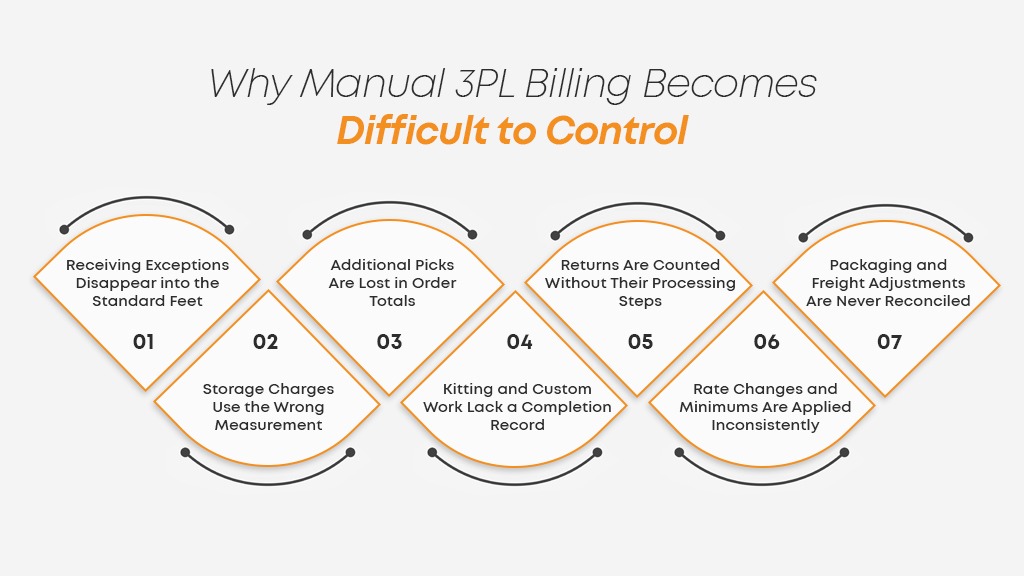
Seven Places Manual Billing Can Miss Warehouse Revenue
1. Receiving Exceptions Disappear into the Standard Fee
Consider an inbound delivery that arrives with mixed cartons and incorrect labels. The receiving team unloads it, separates the stock, applies replacement labels, and completes the receipt.
The receipt proves that the goods arrived. It may not show which additional services were performed or whether those services are separately chargeable.
If the billing team only counts received pallets, the extra work can disappear into the standard receiving fee.
Define the boundary between included receiving activities and separately priced exceptions. For an eligible exception, record the task, completed quantity, client, receipt reference, and required authorization. If labor is billed by time, retain approved time records rather than estimating hours from the gap between receipt creation and closure.
The control is simple: completing a receipt should also prompt the team to resolve any associated billable exceptions.
2. Storage Charges Use the Wrong Measurement
Storage billing errors can arise even when the multiplication is correct. The quantity or measurement period may be wrong.
Suppose a contract charges $0.80 per occupied pallet position per day, using a defined daily snapshot. In a hypothetical 30-day month, the client occupies 100 positions for 20 days and 40 positions for 10 days.
The calculation is:
Storage charge = [(100 × 20) + (40 × 10)] × $0.80 = $1,920
If an employee uses only the month-end balance of 40 positions and multiplies it by 30 days, the result is $960. The difference is $960 for that account and period.
This is an illustrative calculation, not a suggested storage rate or evidence of typical losses. A month-end measurement would be appropriate if the agreement explicitly used that method.
Document what the client pays for: occupied positions, physical pallets, bins, units, reserved space, or another defined measure. Also specify snapshot timing, rounding, partial periods, and treatment of inventory awaiting dispatch or held for inspection. The billing calculation must use the same definitions.
3. Additional Picks Are Lost in Order Totals
An order count alone cannot explain every pick-and-pack charge.
Imagine a contract with a $2.00 fulfillment fee that includes the first item, plus $0.35 for each additional item. A five-item order would generate:
$2.00 + (4 × $0.35) = $3.40
Billing only the base fee omits $1.40. However, the same calculation would be wrong if the agreement charged additional order lines rather than additional units.
Specify whether a charge applies per order, line, item, carton, shipment, or pallet. These quantities are not interchangeable. An order with five units of one SKU can contain one order line, five picked units, and several shipping cartons.
Test cancellations and split shipments too. Shipping one order in two parts should not automatically create two base fees unless that treatment matches the agreement.
4. Kitting and Custom Work Lack a Completion Record
Special projects can be visible to the team performing them but absent from the standard billing export.
A client might authorize assembly of 600 promotional kits. By the billing cutoff, 450 are complete and 150 remain in progress. If the agreement bills completed kits, neither the original request quantity nor the quantity shipped necessarily gives the right invoice amount.
Link the project authorization to completed output and the relevant charging unit. Record separately supplied packaging only when it is separately billable, and preserve any agreed cap or quoted project price.
For warehouses offering kit assembly, this also helps distinguish assembling a kit from later picking and shipping that finished kit. Each service needs an explicit billing treatment so the same work is not charged twice.
5. Returns Are Counted Without Their Processing Steps
A returned parcel can contain several items with different outcomes. One item may be restocked immediately, another may need inspection, and another may require approved disposal.
Counting parcels alone will not capture the correct charges if the agreement prices inspection per item or repacking as a separate service. Conversely, item-level charges should not be added when the return fee already includes them.
Tie return tasks to a return reference and record the completed work, quantity, and disposition. Keep the process specific enough to distinguish authorized client services from rework caused by a warehouse error.
That distinction protects both revenue and the client relationship: correcting your own mistake should not silently become a new customer charge.
6. Rate Changes and Minimums Are Applied Inconsistently
A signed rate change does not protect revenue if the invoice template still contains the previous price.
For example, suppose a receiving rate increases from $4.50 to $5.00 per pallet on an agreed effective date. If 800 eligible pallets received after that date are billed at the old rate, the understatement is $400.
Keep the previous rate available for historical work while applying the new rate to the correct transactions. Define whether the governing date is service completion, receipt, shipment, or another contractually agreed event.
Minimum charges also require care. If a $1,000 minimum applies to eligible monthly services and those services total $850, the top-up is $150. Adding another $1,000 would overbill the client.
Confirm which services count toward the minimum, whether it applies by warehouse or across an account, and how discounts interact with it. Use worked examples when setting up each agreement.
7. Packaging and Freight Adjustments Are Never Reconciled
Client-supplied packaging, warehouse-supplied materials, and standard packaging included in a fulfillment rate can require different treatment. A generic packing total can obscure those differences.
Freight presents another timing issue. A label cost available at shipment creation may differ from a later carrier invoice because of adjustments or credits. Where a client agreement permits passing through those amounts, an unreconciled difference can become an undercharge or an overcharge.
Use a shipment reference to match the original charge, later adjustment, and any credit. Check eligibility before passing anything through. Preserve the connection to the original shipment when an adjustment falls into a later billing period.
How to Audit 3PL Revenue Leakage
Start with a closed billing period and a defined set of clients. Include different service profiles where possible, such as pallet storage, ecommerce fulfillment, and accounts with custom projects. A narrow sample can identify a process defect, but it should not be presented as the loss rate for the entire warehouse.
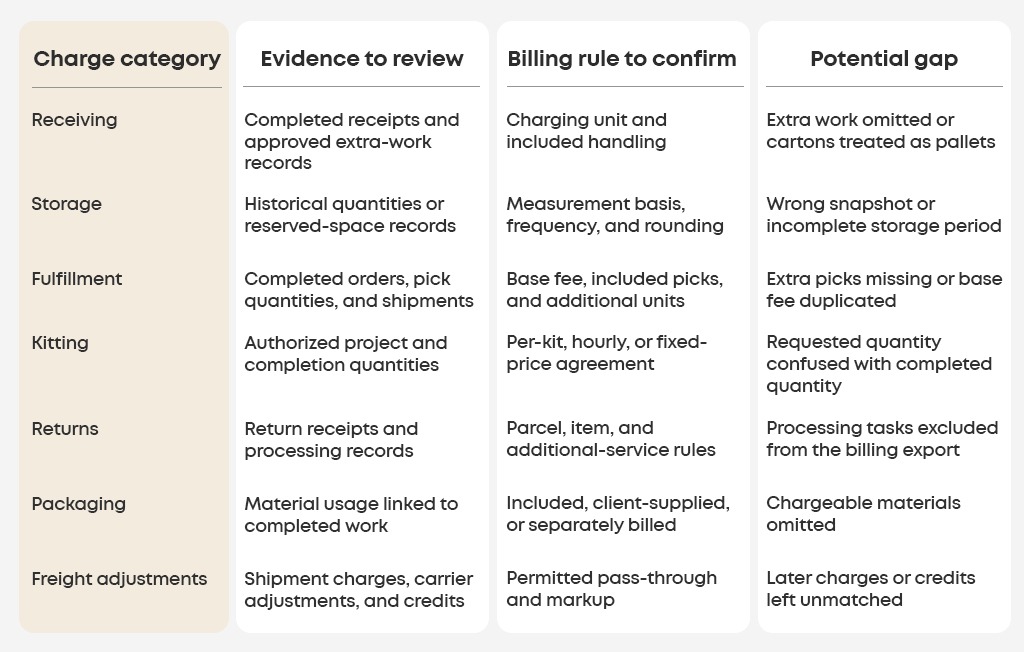
Build the audit from operational evidence and the applicable agreements. Reviewing invoices alone cannot reveal a task that never became an invoice line.
Use a reconciliation table like this:
For each item, calculate the expected charge and compare it with the net amount actually billed for that same work. Keep approved waivers, unresolved questions, undercharges, and overcharges in separate categories.
An illustrative audit might identify the following confirmed omissions:
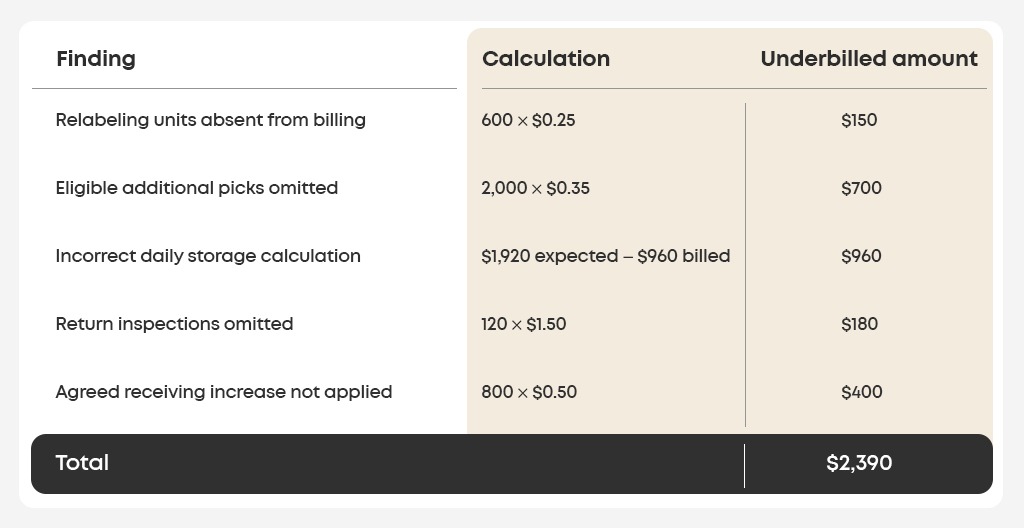
These are hypothetical, non-overlapping findings, not customer results or industry benchmarks. They show why an audit needs both transaction-level checks and agreement-level checks.
For the audited scope, use:
Underbilling rate = Confirmed underbilled amount ÷ Total eligible charge value × 100
If the eligible charge value is $50,000 and confirmed underbilling is $2,390, the rate is 4.78%. The denominator includes the missing charges and reflects approved discounts or waivers. Track overbilling separately rather than subtracting it to make underbilling appear smaller.
Record discovered amounts, corrected invoices, and collected payments separately. Finding an omission does not mean the money has been recovered. Before issuing corrections, confirm the evidence, agreed treatment, and appropriate client communication.
How to Stop Manual Billing Gaps from Returning
Give Each Service an Unambiguous Billing Rule
Create a service catalog that connects warehouse language with invoice language. An employee selecting “relabeling” should be recording a defined service rather than adding an unexplained miscellaneous fee.
For each service, specify the eligible activity, client, unit, price, completion trigger, and any approval requirement. Include how the service behaves when it is bundled, waived, reversed, or partially completed.
Standard service names can simplify administration while allowing negotiated prices to remain client-specific. Multi-client management supports separating client inventory, orders, billing structures, and reporting within a shared warehouse operation.
Make Records Part of Completing the Work
Capture standard activities from the warehouse workflow wherever possible. For exceptional work, provide a short task record tied to the relevant client and transaction.
The record should establish what happened, how much was completed, when it happened, and who confirmed it. An authorization reference matters when extra work requires approval. Warehouse staff should not need to interpret the entire commercial agreement to document a completed task.
Extensiv’s billing guidance also emphasizes recording charges at the point of work and reducing reliance on retrospective reconstruction. The practical application is to make activity capture a normal completion step.
Source: Extensiv’s 3PL billing accuracy guide.
Review Missing Information Before the Billing Cutoff
Set up an exception review for completed tasks with no billing classification, records with missing quantities, expired rate agreements, and charges awaiting authorization.
An intentional zero charge should have a reason. Otherwise, a waived service, an included service, and an unconfigured rate can look identical.
Assign ownership for resolving each exception. Operations can confirm the work and quantity; the account owner can confirm commercial treatment; finance can approve the resulting invoice. Resolve routine questions while the people involved still remember the task.
Build Checks Against Duplicate and Incorrect Charges
Automation needs controls in both directions. A process that captures more revenue but introduces duplicate fees will create disputes and corrective work.
Ask how the billing system handles a receipt reopened for correction, a shipment retried after a connection failure, or a task completed and then reversed. Reprocessing the same record should not create a second charge for the same service.
Storage needs particular attention because successive daily charges may be valid, while two charges for the same client, storage measure, and day may not be.
Keep approved invoice corrections traceable. A reviewer should be able to understand what changed and why without reconstructing several overwritten spreadsheets.
Reconcile the Accounting Handoff
Whether billing and accounting share a platform or use an integration, assign a clear owner for invoice creation and finalization.
Confirm that approved charges reach the correct customer account, currency, billing period, and invoice reference. Compare transfer totals and identify rejected records. A failed transfer should remain visible until resolved, and retrying it should not generate a duplicate invoice.
Test adjustments and credits as well as new invoices. An integration that handles the first invoice correctly can still leave later corrections disconnected from it.
What to Test in Automated 3PL Billing Software
Evaluate warehouse billing automation using a representative agreement and sample transactions from your own operation. A demonstration based entirely on simple per-order charges will not reveal how the system handles your exceptions.
Use a compact acceptance test:
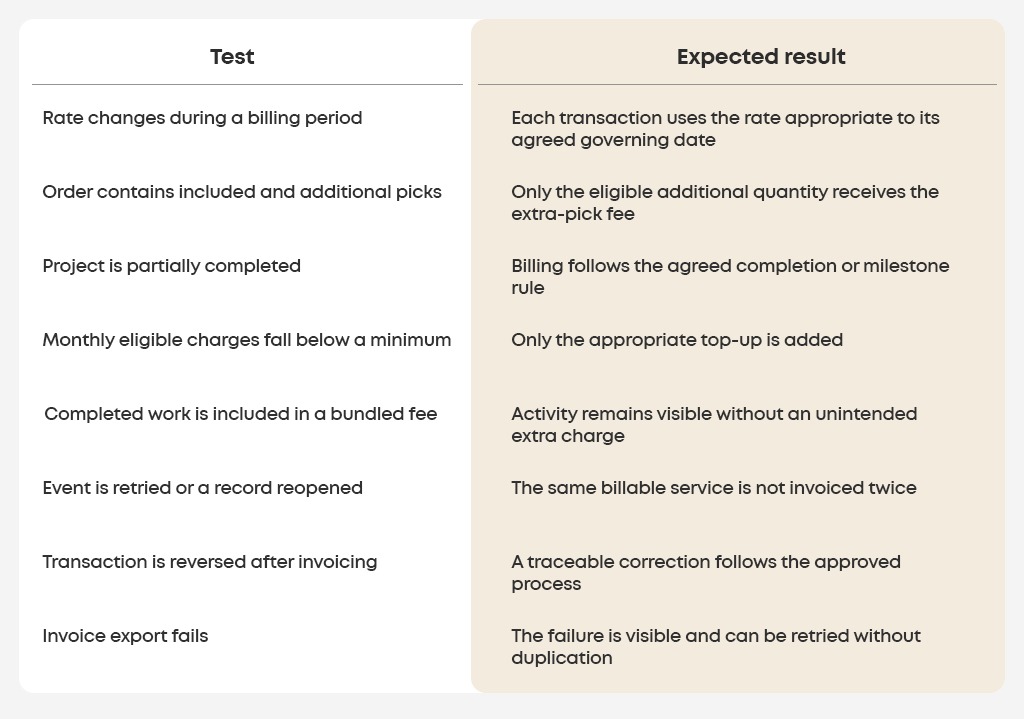
Treat these as evaluation requirements, not capabilities that every WMS automatically includes.
For a warehouse using 3PL WMS software, the key question is whether the activity data is detailed enough to support its agreements. Cloud-based 3PL software can make shared information accessible, but accurate billing still depends on configuration, complete records, and review.
A Practical Rollout for Warehouse Billing Automation
Begin with a small pilot that includes at least one complex client agreement. Using only the simplest account may hide the problems you most need to solve.
First, reconcile the agreement, service catalog, and existing invoice structure. Have operations and finance agree on the expected calculation for each pilot scenario before configuration begins.
Next, run the proposed billing process alongside the existing process for a complete relevant billing cycle. Compare the draft outputs with independently checked expected amounts. The existing spreadsheet is a comparison point, not an unquestionable source of truth.
Investigate every difference. A higher automated total could represent recovered omissions, but it could also reflect duplicate charges, an incorrect storage basis, or excluded services being billed.
Switch the pilot account after the team can explain the results and resolve exceptions consistently. Expand to more clients in controlled groups, retaining checks for different billing frequencies, minimums, and service profiles. Continue testing occasional events, such as rate changes or reversals, even if they did not occur during the pilot period.
Measure Whether the New Process Is Working
Use a small set of measures that separates completeness, accuracy, and speed.
Confirmed underbilling value shows the eligible charges omitted or understated in audited periods. Compare it with eligible charge value to account for changing volumes. Early audits may uncover more historical errors; that does not automatically mean the new process is getting worse.
Unresolved billing exceptions at cutoff shows how much work still lacks a decision. Track both count and known value, and distinguish pending approval from missing operational evidence.
First-pass invoice accuracy measures finalized invoices that need no correction for a defined reason and observation period. For example, track the percentage issued in a month that require no billing-error correction within 30 days. Report underbilling and overbilling causes separately.
Invoice preparation time measures staff effort spent preparing and checking bills. Time saved is additional capacity; it becomes a direct cost saving only when it reduces overtime, outside expense, or another actual cost.
Billing delay measures the time from the agreed billing cutoff to invoice issue. Track payment timing separately to avoid confusing faster invoice preparation with successful collection.
Review these measures by client and charge category. Warehouse-wide totals can hide a recurring problem in returns, storage, or one heavily customized account.

How 3PLNext Supports Warehouse Billing
3PLNext’s 3PL billing software offers automated billing, flexible charging methods such as per unit, per pallet, and per order, customizable invoices, recurring billing setup, and multi-client management. Its published billing guidance also describes client-specific billing profiles and charges based on warehouse activities. Read the 3PLNext billing overview.
To evaluate the fit for your warehouse, bring a sample client agreement, a recent invoice, and examples of work your team currently adds manually. Ask the team to demonstrate how those services would be recorded, calculated, reviewed, and invoiced, including any configuration or integration requirements.
Your warehouse should be able to explain the relationship between the work it completes and the amount it bills. That starts with a clear agreement and continues through every receipt, storage period, fulfillment task, and approved exception.
Request a 3PLNext demo to explore how your client billing requirements can connect with your warehouse workflows.
Frequently Asked Questions
What causes revenue leakage in manual 3PL billing?
Revenue leakage occurs when eligible services are omitted or billed below the agreed amount. Contributing problems include incomplete task records, incorrect units, outdated rates, and poorly defined inclusions. A useful audit checks the agreement and operational evidence as well as the invoice.
How do you calculate lost revenue from warehouse billing errors?
For a defined period, calculate the eligible charge for each audited activity and compare it with the net amount billed for that activity. Total the confirmed undercharges without offsetting them against overcharges. Separate approved waivers, disputed eligibility, corrected invoices, and actual collections.
Can 3PL billing software automate storage charges?
Software can automate storage billing when it supports the contracted measurement and receives the necessary historical data. Verify whether the calculation uses daily occupancy, a periodic snapshot, reserved capacity, or another basis. Test partial periods, rounding, and minimums before using the output on client invoices.
Is every additional warehouse task separately billable?
No. Some tasks are included in a base fee, covered by a fixed project price, waived by agreement, or required to correct a warehouse error. Recording the work helps establish its treatment, but the client agreement and relevant authorization determine whether an extra charge applies.
Will automated billing eliminate all invoice errors?
No. Automation applies configured rules to available records. Missing activities, incorrect rates, ambiguous agreements, and faulty transfers can still produce errors. Test representative scenarios, review exceptions, and retain approval and correction controls.
How can a 3PL reduce invoice disputes?
Use service descriptions the client recognizes and provide a clear basis for each charge. Retain supporting quantities, dates, transaction references, rates, and any required authorizations. Explain corrections clearly and make sure the final invoice follows the agreed service inclusions and pricing.



Leave a Reply