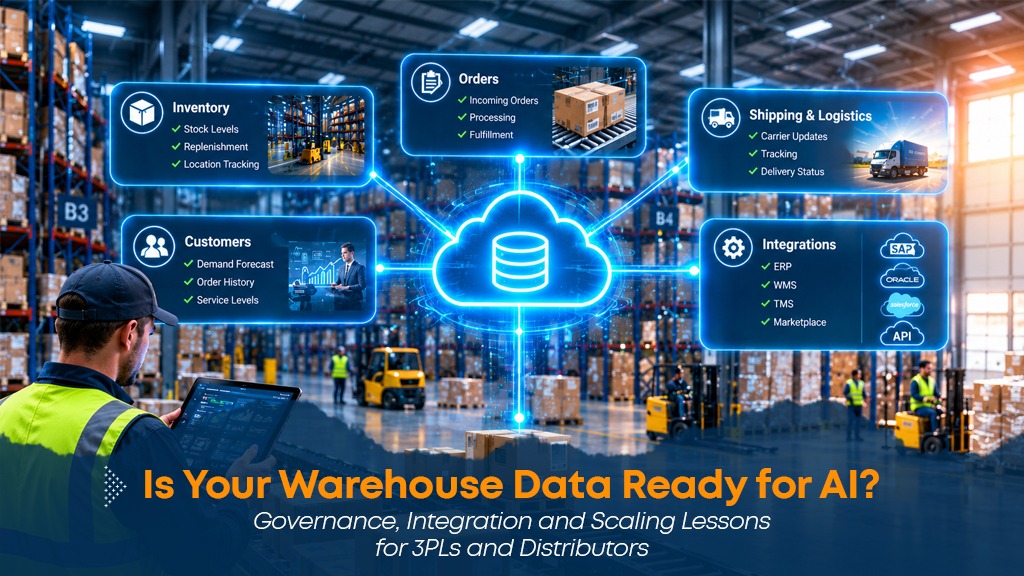
Is Your Warehouse Data Ready for AI Governance, Integration and Scaling Lessons for 3PLs and Distributors
An AI project can work well in one warehouse and still run into trouble when a business tries to introduce it to another location.
One location might have accurate inventory records, well-maintained integrations and a team that understands the process. Another may rely on spreadsheets to fill gaps between systems. When the same AI tool is introduced at both sites, the results may be very different.
That is why warehouse data deserves attention before a business starts expanding its use of AI. The questions are straightforward: where is the information coming from, who is allowed to see it, and can the system be trusted to use it correctly?
AutoStore’s white paper, Intelligent Automation in Warehousing: An AI Roadmap, examines these concerns through a survey of 127 warehouse decision-makers and automation partners, supported by outside research. The findings show that confidence in data protection is limited and that integration problems become more obvious as companies try to scale.
For 3PLs and distributors, this is not only a technology concern. It affects client relationships, operational accuracy and the ability to repeat a successful rollout across several warehouses.
Where Does Your Warehouse Data Go?
A warehouse generates data all day. Goods are received, stock is moved, orders are picked, shipments leave the building and inventory records change. Much of that information also passes between the WMS, ERP, ecommerce platforms and shipping systems.
AI needs access to relevant records to produce useful answers. But giving a system access to operational information raises questions about privacy, security and control.
In AutoStore’s survey, only 41% of end-user customers and 46% of integration partners said they were confident that the AI systems they used protected sensitive customer and operational data. Another 33% in each group were neutral.
A neutral answer is important. It does not necessarily mean a business has suffered a data breach. It may mean the people responsible for operations simply cannot explain what happens to their data after it enters an AI system.
That uncertainty is a problem when a customer asks whether their order history or inventory figures are visible to anyone else. Businesses need answers that can be checked, rather than general assurances that their information is safe.
The AutoStore paper also discusses growing regulatory expectations, including the EU AI Act. The specific obligations and penalties depend on how a system is used and which rules apply, but the direction is clear: companies need to know what data their technology uses and how it is protected.
Why This Matters More for 3PLs & Distributors
A 3PL is responsible for handling information that belongs to several businesses, often within the same warehouse operation.
One client may ship hundreds of orders each day. Another may have seasonal demand, different pricing arrangements or confidential customer information. The 3PL needs visibility across its operation, but that does not mean every user or client should see every record.
AI adds another place where those boundaries need to be understood. If an employee asks about a particular customer’s stock, is the answer restricted to information they are authorized to access? If a report combines figures from multiple clients, who can view it? These are questions a warehouse operator should resolve with its technology provider before expanding access.
Distributors have similar concerns. Supplier terms, customer histories, pricing and stock availability may be spread across several platforms. Connecting those systems is useful, but it also makes it necessary to define how information moves between them.
Good data governance helps protect that information and makes it easier to explain the controls to customers, partners and internal teams.
Five Traits of Strong Warehouse Data Governance
The AutoStore report identifies several practices associated with stronger AI data governance. For warehouse businesses, they translate into five practical priorities.
1. Keep operational information consistent
If one system says a product is available and another shows it as allocated, AI has no reliable starting point. Keeping inventory, orders and other core records consistent across connected systems reduces confusion before it reaches the AI tool.
This does not mean every business must replace its existing software. It means there should be a clear understanding of which system owns each important record and how changes are passed between the integrated systems.
2. Treat data as a business asset
Order histories, customer information and inventory trends help warehouses plan labor, manage stock, deliver better service and improvise their internal warehouse operations. They deserve the same care as other valuable company resources. Decisions about how AI can use that information should be made before a rollout, not after somebody raises a concern.
3. Make data access understandable
Warehouse leaders should be able to explain what information an AI tool uses, who has permission to access it and who is responsible for reviewing those permissions. Staff should also know where to raise questions about an unexpected result.
4. Avoid unnecessary custom connections
Every connection between systems needs maintenance. As the number of integrations grows, so does the effort required to troubleshoot problems and confirm data is moving correctly. Standardized integrations make it easier to manage the same process across different warehouses.
5. Use established governance standards as a guide
The paper refers to ISO/IEC 42001, a standard for AI management systems. It gives buyers a useful way to ask vendors about risk management, oversight and accountability. Being aligned with a standard is not the same as being certified, so businesses should check exactly what a provider claims and what evidence supports it.
None of these practices is particularly glamorous. They are the everyday controls that allow a warehouse to use more technology without losing track of its information.
From Pilot to Production: Why Scaling AI Is Hard
A pilot often benefits from extra attention. The team knows which data to use, technical issues are handled quickly and a limited number of people are involved.
Expansion is different. The new warehouse or a different location may have older software, different client processes or integrations built by another provider. Problems that seemed minor during the pilot become harder to manage when repeated at several locations.
AutoStore found an interesting difference between customers and integration partners. Asked whether they wanted to use more AI but their existing systems could not yet support it, 42% of partners agreed, compared with 19% of customers.
The people maintaining integrations may be seeing obstacles that are less visible to the people using the software each day. A manager might see an AI report working correctly on screen without knowing how many manual fixes were needed to make the underlying systems communicate.
There is also a people problem. Expanding AI requires staff who can manage integrations, review access, maintain data quality and support employees. If those responsibilities are unclear, a promising project can take much longer than expected.
Four Foundations for Scaling Warehouse AI
Businesses that want to expand AI across multiple operations should plan for repeatability. The following four areas, drawn from AutoStore’s research, deserve particular attention.
1. A shared view of operational data.
Core information should be consistent enough that each warehouse is not working from a different version of the truth. When the same definitions and data rules apply across sites, reporting and analysis become easier to compare.
2. Reliable, documented integrations.
Connecting the WMS with ERP, ecommerce and other operational systems should not require reinventing the process for every location. Clear integration standards make support and future changes more manageable.
3. A rollout that grows with the business.
Introducing AI in stages gives the team time to check whether it is useful and deal with problems before more users depend on it. The paper references Deloitte research supporting deeper transformation through progressive adoption rather than superficial use of AI tools.
4. Results measured at each location.
A successful pilot needs evidence. Did reporting take less time? Were exceptions identified sooner? Did managers gain a clearer view of inventory or order performance? Those results should be assessed at the site where the tool was introduced before assuming they will transfer everywhere.
The aim is to make the second deployment easier to manage than the first, not to repeat the same setup problems at every site.

Leadership, Not Location, Drives AI Confidence
AutoStore’s survey found higher average AI usage, trust and adoption scores among its Asia-based respondents than among respondents in the United States. For example, the average usage score was 4.27 out of 5 in Asia, compared with 3.44 in the US. Trust scores were 3.80 and 3.15 respectively, while adoption scores were 3.97 and 3.14.
Those differences are interesting, but the regional samples were small. They should not be taken as proof that one region’s warehouses are better prepared than another’s.
The broader point in the paper concerns leadership. It cites Forrester research showing that direct CEO ownership of AI strategy was reported by 33% of organizations in Asia-Pacific, compared with 18% in North America and 8% in Europe. Senior involvement can help when decisions require cooperation between operations, IT and management.
That does not mean the CEO should select every warehouse tool. Operational teams still need to test whether the technology works for them. Good leadership gives those teams the time, resources and authority to evaluate a project properly.
The report also cites a Gartner prediction that many supply chain digital adoption efforts will fail to deliver their expected value by 2028 because businesses have underinvested in learning and development. Buying technology is only one part of the job. People need time to learn how to use it well.
An AI-Readiness Checklist for Warehouse Leaders
Before expanding an AI project, it is worth discussing a few basic questions with operations, IT and the software provider.
- Do our WMS, ERP and other systems agree on the inventory and order figures we depend on?
- Do we know what data the AI tool uses and where that information goes?
- Are users restricted to the client and operational records they are supposed to access?
- Are our integrations documented and manageable across more than one location?
- Can our provider explain how it handles AI risk, privacy and oversight?
- Have we measured whether the first deployment actually improved a business process?
- Who will train users, investigate problems and take responsibility for the rollout?
If the answers are unclear, a bigger AI deployment may only make existing problems more difficult to manage. Addressing those issues first gives the next stage a much stronger chance of working.
How 3PLNext Helps Build AI-Ready Foundations
3PLNext brings essential warehouse processes into one cloud-based WMS, including receiving, inventory, picking, fulfillment and billing. For teams managing several customers or facilities, having those activities available in one operational system can reduce the time spent gathering information from separate tools.
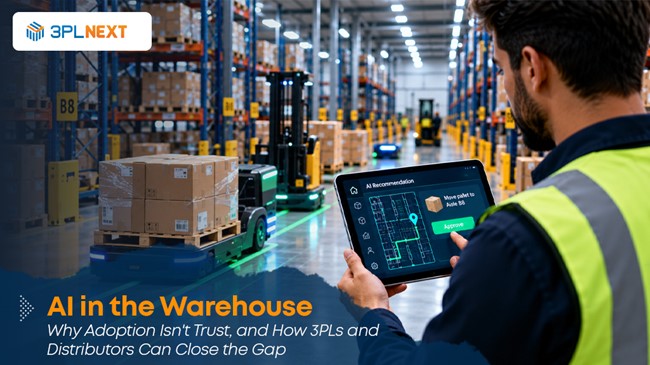
The platform supports multi-client warehouse operations and connects with ecommerce and business systems, including Shopify, Magento, WooCommerce, QuickBooks, eBay and Daraz. Its AI Assistant allows users to ask questions in simple language using current operational data available through the WMS.
For a warehouse manager, that can mean getting an answer to an operational question without first assembling several reports. For a 3PL managing multiple customers, it also means having a common system for day-to-day warehouse activity.
A connected WMS is not, by itself, a complete AI governance program. Businesses still need to review access permissions, their data protection requirements and the way connected systems are managed. But reliable operational records are an important place to begin.
The Bottom Line
Getting AI to work in one warehouse is only the start. Making it useful across several sites requires dependable data, integrations that can be maintained and people who know how to manage technology.
Before adding more AI tools, warehouse leaders should be able to explain where their information comes from, who can access it and how they will know whether a rollout has worked.
For 3PLs and distributors, these are not just IT questions. They affect inventory accuracy, customer confidence and day-to-day service. Answer them well, and expanding AI becomes a more manageable business decision.
Source: AutoStore, Intelligent Automation in Warehousing: An AI Roadmap, including research from Deloitte, Forrester, Gartner, Stanford HAI and SmartDev as cited in the white paper. Figures should be verified against the original publications before release.


Leave a Reply