AI in Warehouse Management: Closing the Trust Gap
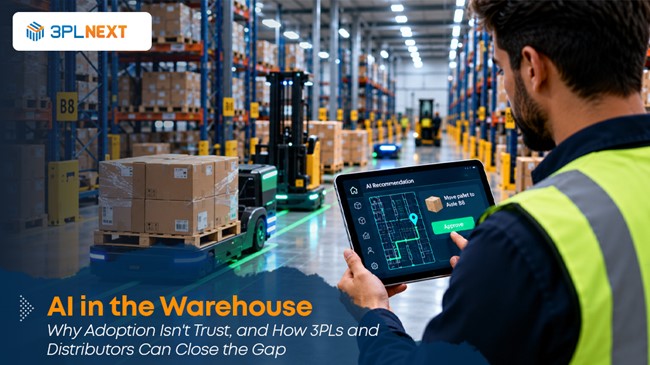
AI in the Warehouse vs. Real Trust, and How 3PLs and Distributors Can Close the Gap
Warehouse managers are used to working with imperfect information. A late inbound delivery, an unexpected stock discrepancy or a sudden rush of orders that can change the entire shift. The last thing they need is another system telling them what to do without giving them a good reason.
That is part of the challenge faced by AI in warehouse management. AI can find patterns in inventory movements, highlight exceptions and help teams get answers faster. But being useful and being trusted are not the same thing.
AutoStore explored this difference in its white paper, Intelligent Automation in Warehousing: An AI Roadmap. Its research includes responses from 127 warehouse decision-makers and automation partners, alongside findings from other industry studies. One message run through the report: warehouses are interested in AI, but they are more careful about the decisions they will let it make and the value they will give to AI recommendations.
For 3PL operators, the consequences of a wrong decision can extend to several clients. For distributors, a poor inventory or fulfillment decision can affect customer commitments and the rest of the supply chain. Both have good reasons to expect more than a confident-looking answer on a screen.
The Confidence Gap Is Real
In AutoStore’s survey, 58% of end-user customers said they used AI frequently, while 69% believed using more AI could improve their operations. Those findings suggest that warehouse teams see its potential and are willing to work with it.
The answers changed when the question became more serious: is the AI currently in use accurate enough for critical decisions? Only 42% of customers agreed, while 35% disagreed. The others were undecided. Integration partners also gave mixed responses.
Think about how this plays out during a normal day. A supervisor may be happy to use AI to identify orders at risk of missing dispatch. That same supervisor may not want the system to change available stock, approve a large replenishment or adjust a customer’s charges without someone checking first.
There is a reason for that caution. The AutoStore paper also cites PwC research in which more than half of global CEOs reported no revenue or cost benefits from their AI initiatives. Businesses have heard ambitious technology promises before. Warehouse teams tend to judge new tools by what actually happens on the floor.
AI therefore has to earn trust through results, not simply through how often people use it.
“Critical” Is the Word That Matters
There is a big difference between helping someone make a decision and making that decision for them.
AI can be useful when it spots a picking delay, answers an inventory question or suggests where a team should focus next. The risk changes when software is allowed to act without approval, particularly when the action affects customer orders, inventory accuracy or money.
A Research done by ABI, cited by AutoStore, reflects this distinction. It found that 94% of supply chain leaders planned to use AI to support decisions. The figure was lower, at 76%, for autonomous actions, and that interest was mainly in clearly defined activities such as reordering or rerouting.
One interview participant in AutoStore’s research said they would expect 99.9% accuracy before trusting AI with decisions that could have a million-dollar impact. Not every warehouse decision carries that level of financial exposure, but the underlying concern is familiar: a wrong recommendation is inconvenient; an unchecked wrong action can become an expensive operational problem.
A sensible approach is to give AI more responsibility gradually. Let it flag a possible stock issue first. Compare its recommendation with the warehouse records. See whether the team would have reached the same conclusion. Only then consider allowing it to handle a narrow, low-risk task on its own.
What Actually Builds Trust in Warehouse AI
The AutoStore report points to several conditions that make warehouse teams more willing to rely on AI. None of them requires removing people from the process.
1. It understands the warehouse’s actual data
Every operation works differently. A multi-client 3PL has service commitments and billing arrangements that may vary by customer. A distributor may handle different order patterns, stock priorities and replenishment rules. Recommendations become more useful when they reflect those realities rather than general assumptions about warehouse operations.
2. People can check what it is telling them
If AI flags a sudden increase in late orders, a supervisor should be able to check the underlying figures. If it points to a recurring inventory issue, the team needs sufficient information to investigate. An answer that cannot be verified is difficult to trust, especially when it affects important decisions.
3. Its performance is measured
Trust becomes stronger when there is a record of what the system recommended and whether that recommendation helped. The white paper cites EY research finding that large enterprises experienced financial losses linked to AI risks, while organizations with real-time AI monitoring were more likely to report cost savings and revenue growth.
Warehouse leaders can apply the same principle on a practical level. Review the exceptions AI identified, the issues it missed and the time it saved. That gives teams something more useful than a vendor promise.
4. It works with the systems people already use
An AI tool may look impressive in a demonstration and still disappoint once it is connected to real operations. If inventory information is outdated or order statuses do not match the WMS, employees quickly lose confidence. The closer AI is to reality & accurate warehouse records, the easier it is for teams to judge whether its answers are useful and can be trusted or not.
5. Someone takes responsibility for adoption
The paper cites Gartner research indicating that only 23% of supply chain organizations have a formal AI strategy. Without clear ownership, individual projects can end up disconnected from one another. Warehouse teams need to know what the tool is for, who is responsible for it and what to do when its answer seems wrong.
Adoption: The Other Half of Trust
Even a reliable system will have little value if it is too complicated to use during a busy shift.
Only 52% of customers in AutoStore’s survey agreed that their AI tools were intuitive and required no special training. The same percentage felt their systems were easy to integrate and worth the effort. That leaves a substantial group that is still dealing with practical difficulties.
Training matters, but warehouse employees do not have to become AI specialists. As the OECD research cited in the paper explains, most workers who use AI need basic understanding of the technology, not advanced technical skills. They should know how to ask useful questions, read the response and recognize when a recommendation needs checking.
Managers need that confidence too. The report cites an ABC Supply Chain survey in which 97% of supply chain professionals viewed AI as part of their role, but only around 20% felt able to evaluate an AI project and only 18% of managers felt they are capable of working with an AI system.
Leadership can make a noticeable difference. BCG research referenced in the paper found that positive employee sentiment toward AI increased from 15% to 55% where leadership support was strong.
The purpose it to help people learn and adopt this specially those who are familiar to AI. Show them a demonstration of how discrepancies can be highlighted through AI and help them fix it. Show a warehouse manager how to check late shipments or compare operational figures. Always be open to question and answers with employees, as they are all in the learning phase. Assign them tasks through AI, the task they familiar with, so they are sure about the answers as that would build their trust if AI answers them correctly as per their knowledge.
A Practical Playbook for 3PLs, Manufacturers and Distribution Leaders
There is no need to hand over major operational decisions on day one. A more useful starting point is to choose a handful of tasks where the result can be checked easily.
Decide what AI can and cannot do. List down which activities are for suggestions only and which can be automated. Changes to client inventory, invoices or other sensitive records should be managed manually, no need to rush that side with AI at the start.
Start with one clear problem. This could be slow reporting, missed picking exceptions or difficulty finding the cause of late dispatches. Choose a measurable problem rather than rolling out AI simply because the technology is available.
Make verification part of the routine. Supervisors should know where to look for the numbers behind an answer and how to report a result that seems wrong.
Track what changes. Compare performance before and after the tool is introduced. Look at time spent searching for information, the speed of resolving exceptions and the quality of the answers.
Train people according to their work. A picker, a client service representative and an operations manager will use the system differently. Training should reflect those differences, not everyone should be trained equally with similar skills.
Share what works across locations. For businesses operating several warehouses, a consistent process for training, reviewing results and handling exceptions is more useful than letting each site figure everything out alone.
Keep management involved. Employees notice whether leaders use the information themselves and whether they respond when something does not work. Always keep an open-door policy.
These are simple steps, but together they help turn AI from an occasional experiment into something a team can use with confidence.
How 3PLNext Approaches AI in the Warehouse
3PLNext powers daily warehouse operations with AI-enabled warehouse management system.
With the 3PLNext AI Assistant, warehouse managers can ask questions in everyday language and get answers based on operational data in the WMS. Instead of spending time moving between reports to find a figure, they can ask about inventory, orders or warehouse performance and use the response to decide what needs attention.
That is particularly useful for 3PLs managing several customers and for distributors dealing with large volumes of stock and orders. The aim is not to replace a supervisor’s judgment. It is to make the information behind that judgment easier to find or not always looking for the supervisor when anything requires a decision.
AI is far more valuable when teams can relate its answers to the work they do every day. A warehouse manager who can check an answer against current operations has a better reason to use it again.
The Bottom Line
Warehouse teams are already trying AI. What they are still deciding is how much responsibility to give it.
That decision should come down to evidence. Does the system use reliable warehouse information? Can someone check its answers? Has it helped solve a real operational problem? Do employees know when they should step in?
For 3PLs and distributors, getting those basics right matters more than adding another AI feature to a software list. People are much more likely to trust a tool when it consistently helps them do their jobs well rather than creating another issue for them.
Source: AutoStore, Intelligent Automation in Warehousing: An AI Roadmap, including research from PwC, ABI Research, EY, Gartner, OECD, ABC Supply Chain and BCG as cited in the white paper. Figures should be verified against the original publications before release.
AI in the Warehouse vs. Real Trust, and How 3PLs and Distributors Can Close the Gap
Warehouse managers are used to working with imperfect information. A late inbound delivery, an unexpected stock discrepancy or a sudden rush of orders that can change the entire shift. The last thing they need is another system telling them what to do without giving them a good reason.
That is part of the challenge faced by AI in warehouse management. AI can find patterns in inventory movements, highlight exceptions and help teams get answers faster. But being useful and being trusted are not the same thing.
AutoStore explored this difference in its white paper, Intelligent Automation in Warehousing: An AI Roadmap. Its research includes responses from 127 warehouse decision-makers and automation partners, alongside findings from other industry studies. One message run through the report: warehouses are interested in AI, but they are more careful about the decisions they will let it make and the value they will give to AI recommendations.
For 3PL operators, the consequences of a wrong decision can extend to several clients. For distributors, a poor inventory or fulfillment decision can affect customer commitments and the rest of the supply chain. Both have good reasons to expect more than a confident-looking answer on a screen.
The Confidence Gap Is Real
In AutoStore’s survey, 58% of end-user customers said they used AI frequently, while 69% believed using more AI could improve their operations. Those findings suggest that warehouse teams see its potential and are willing to work with it.
The answers changed when the question became more serious: is the AI currently in use accurate enough for critical decisions? Only 42% of customers agreed, while 35% disagreed. The others were undecided. Integration partners also gave mixed responses.
Think about how this plays out during a normal day. A supervisor may be happy to use AI to identify orders at risk of missing dispatch. That same supervisor may not want the system to change available stock, approve a large replenishment or adjust a customer’s charges without someone checking first.
There is a reason for that caution. The AutoStore paper also cites PwC research in which more than half of global CEOs reported no revenue or cost benefits from their AI initiatives. Businesses have heard ambitious technology promises before. Warehouse teams tend to judge new tools by what actually happens on the floor.
AI therefore has to earn trust through results, not simply through how often people use it.
“Critical” Is the Word That Matters
There is a big difference between helping someone make a decision and making that decision for them.
AI can be useful when it spots a picking delay, answers an inventory question or suggests where a team should focus next. The risk changes when software is allowed to act without approval, particularly when the action affects customer orders, inventory accuracy or money.
A Research done by ABI, cited by AutoStore, reflects this distinction. It found that 94% of supply chain leaders planned to use AI to support decisions. The figure was lower, at 76%, for autonomous actions, and that interest was mainly in clearly defined activities such as reordering or rerouting.
One interview participant in AutoStore’s research said they would expect 99.9% accuracy before trusting AI with decisions that could have a million-dollar impact. Not every warehouse decision carries that level of financial exposure, but the underlying concern is familiar: a wrong recommendation is inconvenient; an unchecked wrong action can become an expensive operational problem.
A sensible approach is to give AI more responsibility gradually. Let it flag a possible stock issue first. Compare its recommendation with the warehouse records. See whether the team would have reached the same conclusion. Only then consider allowing it to handle a narrow, low-risk task on its own.
What Actually Builds Trust in Warehouse AI
The AutoStore report points to several conditions that make warehouse teams more willing to rely on AI. None of them requires removing people from the process.
1. It understands the warehouse’s actual data
Every operation works differently. A multi-client 3PL has service commitments and billing arrangements that may vary by customer. A distributor may handle different order patterns, stock priorities and replenishment rules. Recommendations become more useful when they reflect those realities rather than general assumptions about warehouse operations.
2. People can check what it is telling them
If AI flags a sudden increase in late orders, a supervisor should be able to check the underlying figures. If it points to a recurring inventory issue, the team needs sufficient information to investigate. An answer that cannot be verified is difficult to trust, especially when it affects important decisions.
3. Its performance is measured
Trust becomes stronger when there is a record of what the system recommended and whether that recommendation helped. The white paper cites EY research finding that large enterprises experienced financial losses linked to AI risks, while organizations with real-time AI monitoring were more likely to report cost savings and revenue growth.
Warehouse leaders can apply the same principle on a practical level. Review the exceptions AI identified, the issues it missed and the time it saved. That gives teams something more useful than a vendor promise.
4. It works with the systems people already use
An AI tool may look impressive in a demonstration and still disappoint once it is connected to real operations. If inventory information is outdated or order statuses do not match the WMS, employees quickly lose confidence. The closer AI is to reality & accurate warehouse records, the easier it is for teams to judge whether its answers are useful and can be trusted or not.
5. Someone takes responsibility for adoption
The paper cites Gartner research indicating that only 23% of supply chain organizations have a formal AI strategy. Without clear ownership, individual projects can end up disconnected from one another. Warehouse teams need to know what the tool is for, who is responsible for it and what to do when its answer seems wrong.
Adoption: The Other Half of Trust
Even a reliable system will have little value if it is too complicated to use during a busy shift.
Only 52% of customers in AutoStore’s survey agreed that their AI tools were intuitive and required no special training. The same percentage felt their systems were easy to integrate and worth the effort. That leaves a substantial group that is still dealing with practical difficulties.
Training matters, but warehouse employees do not have to become AI specialists. As the OECD research cited in the paper explains, most workers who use AI need basic understanding of the technology, not advanced technical skills. They should know how to ask useful questions, read the response and recognize when a recommendation needs checking.
Managers need that confidence too. The report cites an ABC Supply Chain survey in which 97% of supply chain professionals viewed AI as part of their role, but only around 20% felt able to evaluate an AI project and only 18% of managers felt they are capable of working with an AI system.
Leadership can make a noticeable difference. BCG research referenced in the paper found that positive employee sentiment toward AI increased from 15% to 55% where leadership support was strong.
The purpose it to help people learn and adopt this specially those who are familiar to AI. Show them a demonstration of how discrepancies can be highlighted through AI and help them fix it. Show a warehouse manager how to check late shipments or compare operational figures. Always be open to question and answers with employees, as they are all in the learning phase. Assign them tasks through AI, the task they familiar with, so they are sure about the answers as that would build their trust if AI answers them correctly as per their knowledge.
A Practical Playbook for 3PLs, Manufacturers and Distribution Leaders
There is no need to hand over major operational decisions on day one. A more useful starting point is to choose a handful of tasks where the result can be checked easily.
Decide what AI can and cannot do. List down which activities are for suggestions only and which can be automated. Changes to client inventory, invoices or other sensitive records should be managed manually, no need to rush that side with AI at the start.
Start with one clear problem. This could be slow reporting, missed picking exceptions or difficulty finding the cause of late dispatches. Choose a measurable problem rather than rolling out AI simply because the technology is available.
Make verification part of the routine. Supervisors should know where to look for the numbers behind an answer and how to report a result that seems wrong.
Track what changes. Compare performance before and after the tool is introduced. Look at time spent searching for information, the speed of resolving exceptions and the quality of the answers.
Train people according to their work. A picker, a client service representative and an operations manager will use the system differently. Training should reflect those differences, not everyone should be trained equally with similar skills.
Share what works across locations. For businesses operating several warehouses, a consistent process for training, reviewing results and handling exceptions is more useful than letting each site figure everything out alone.
Keep management involved. Employees notice whether leaders use the information themselves and whether they respond when something does not work. Always keep an open-door policy.
These are simple steps, but together they help turn AI from an occasional experiment into something a team can use with confidence.
How 3PLNext Approaches AI in the Warehouse
3PLNext powers daily warehouse operations with AI-enabled warehouse management system.
With the 3PLNext AI Assistant, warehouse managers can ask questions in everyday language and get answers based on operational data in the WMS. Instead of spending time moving between reports to find a figure, they can ask about inventory, orders or warehouse performance and use the response to decide what needs attention.
That is particularly useful for 3PLs managing several customers and for distributors dealing with large volumes of stock and orders. The aim is not to replace a supervisor’s judgment. It is to make the information behind that judgment easier to find or not always looking for the supervisor when anything requires a decision.
AI is far more valuable when teams can relate its answers to the work they do every day. A warehouse manager who can check an answer against current operations has a better reason to use it again.

The Bottom Line
Warehouse teams are already trying AI. What they are still deciding is how much responsibility to give it.
That decision should come down to evidence. Does the system use reliable warehouse information? Can someone check its answers? Has it helped solve a real operational problem? Do employees know when they should step in?
For 3PLs and distributors, getting those basics right matters more than adding another AI feature to a software list. People are much more likely to trust a tool when it consistently helps them do their jobs well rather than creating another issue for them.
Source: AutoStore, Intelligent Automation in Warehousing: An AI Roadmap, including research from PwC, ABI Research, EY, Gartner, OECD, ABC Supply Chain and BCG as cited in the white paper. Figures should be verified against the original publications before release.

Leave a Reply