3PLvs4PLvs5PL
3PL vs 4PL vs 5PL: What’s the Difference and Which Logistics Model is Right for Your Business?
As businesses grow, so do their logistics challenges. Managing inventory, warehousing, transportation, and order fulfillment becomes increasingly complex especially when serving customers across multiple regions and sales channels. To keep operations efficient and scalable, many companies choose to outsource some or all of their supply chain activities to logistics providers.
This is where terms like 3PL, 4PL, and 5PL come into play. While these logistics models are often mentioned together, they serve different purposes and offer varying levels of responsibility, coordination, and technology.
Understanding the differences between these models is essential for choosing the right logistics partner. Whether you’re an eCommerce retailer, manufacturer, wholesaler, or enterprise business, selecting the right logistics approach can improve efficiency, reduce costs, and support long-term growth.
In this guide, we’ll briefly explain the development of logistics outsourcing from 1PL to 5PL before comparing the three most common models in detail.
Understanding the Growth of Logistics
Over the years, logistics has evolved from businesses handling everything themselves to highly integrated, technology-driven supply chains. Each logistics model represents a different level of outsourcing and operational responsibility.
What is First-Party Logistics (1PL)?
First-Party Logistics (1PL) is the most basic logistics model. The business manages every aspect of its supply chain internally, including warehousing, transportation, inventory, and deliveries.
For example, a local furniture manufacturer that owns its warehouse, operates its own delivery trucks, and manages customer deliveries without external partners is operating as a 1PL.
Best suited for:
- Small businesses
- Local manufacturers
- Companies with limited delivery networks
What is Second-Party Logistics (2PL)?
Second-Party Logistics (2PL) involves outsourcing transportation while the business continues managing warehousing and inventory internally.
A 2PL provider typically owns transportation assets such as trucks, ships, or aircraft and is responsible for moving goods between locations.
For example, a manufacturer that stores products in its own warehouse but hires a freight carrier to transport shipments to distributors is using a 2PL model.
Best suited for:
- Manufacturers
- Import/export businesses
- Companies that only require transportation services
What is Third-Party Logistics (3PL)?
Third-Party Logistics (3PL) providers manage day-to-day logistics operations on behalf of businesses. Instead of handling only transportation, they also manage warehousing, inventory storage, order fulfillment, picking, packing, shipping, and returns.
A typical 3PL partner allows businesses to outsource operational logistics while focusing on core activities such as sales, marketing, and product development.
A modern 3PL provider typically offers:
- Warehousing and storage
- Inventory management
- Receiving and putaway
- Order fulfillment
- Pick and pack services
- Shipping coordination
- Returns management
- Multi-carrier integrations
Today, most successful 3PL providers rely on cloud-based Warehouse Management Systems (WMS) to automate warehouse operations, improve inventory accuracy, manage multiple clients, and provide real-time visibility into inventory and orders.
Best suited for:
- eCommerce Businesses
- Retailers
- Wholesale Distributors
- Growing Manufacturers
- Businesses looking to scale without investing in warehouse infrastructure
What is Fourth-Party Logistics (4PL)?
A Fourth-Party Logistics (4PL) provider manages the entire supply chain rather than performing individual logistics tasks.
Unlike a 3PL, which executes warehouse and fulfillment operations, a 4PL acts as a strategic partner that coordinates multiple logistics providers, transportation companies, warehouses, and technology platforms.
For example, an international manufacturer working with several regional warehouses and shipping partners may hire a 4PL to oversee the entire supply chain, optimize costs, and improve operational efficiency.
Typical 4PL responsibilities include:
- Supply chain strategy
- Vendor management
- Transportation planning
- Performance monitoring
- Network optimization
- Technology integration
Best suited for:
- Large enterprises
- Businesses with complex supply chains
- Organizations managing multiple logistics providers
What is Fifth-Party Logistics (5PL)?
Fifth-Party Logistics (5PL) is the most advanced logistics model. It focuses on optimizing entire logistics networks using technologies such as Artificial Intelligence (AI), automation, predictive analytics, and cloud-based supply chain platforms.
Rather than managing a single supply chain, a 5PL provider coordinates multiple logistics networks across different organizations and regions, helping businesses improve efficiency and reduce costs through data-driven decision-making.
A 5PL provider may:
- Optimize transportation routes
- Forecast inventory demand
- Automate carrier selection
- Improve supply chain visibility
- Reduce logistics costs using AI and advanced analytics
Best suited for:
- Global enterprises
- International retailers
- Large manufacturers
- Businesses operating across multiple countries
The Evolution from 1PL to 5PL
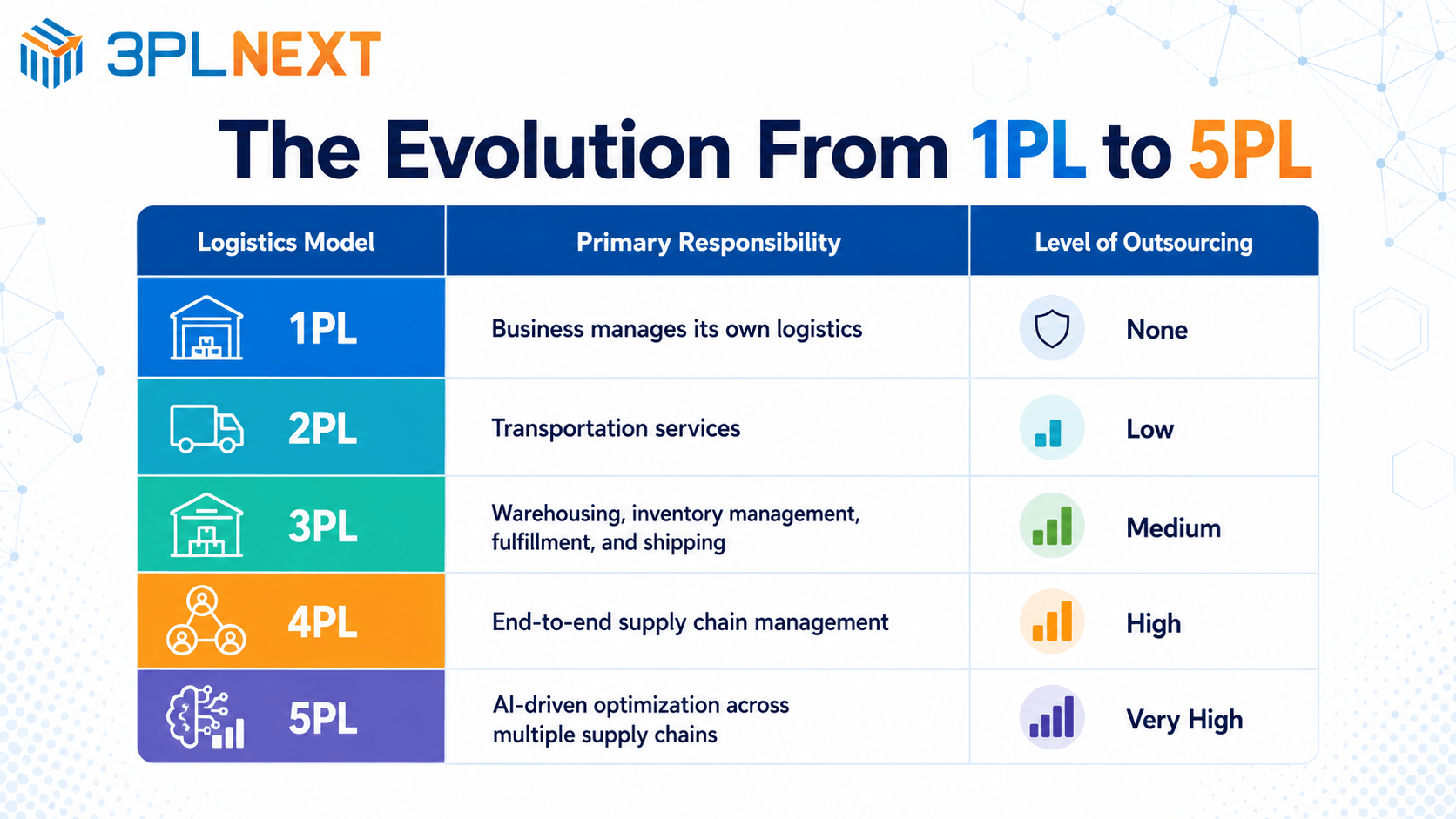
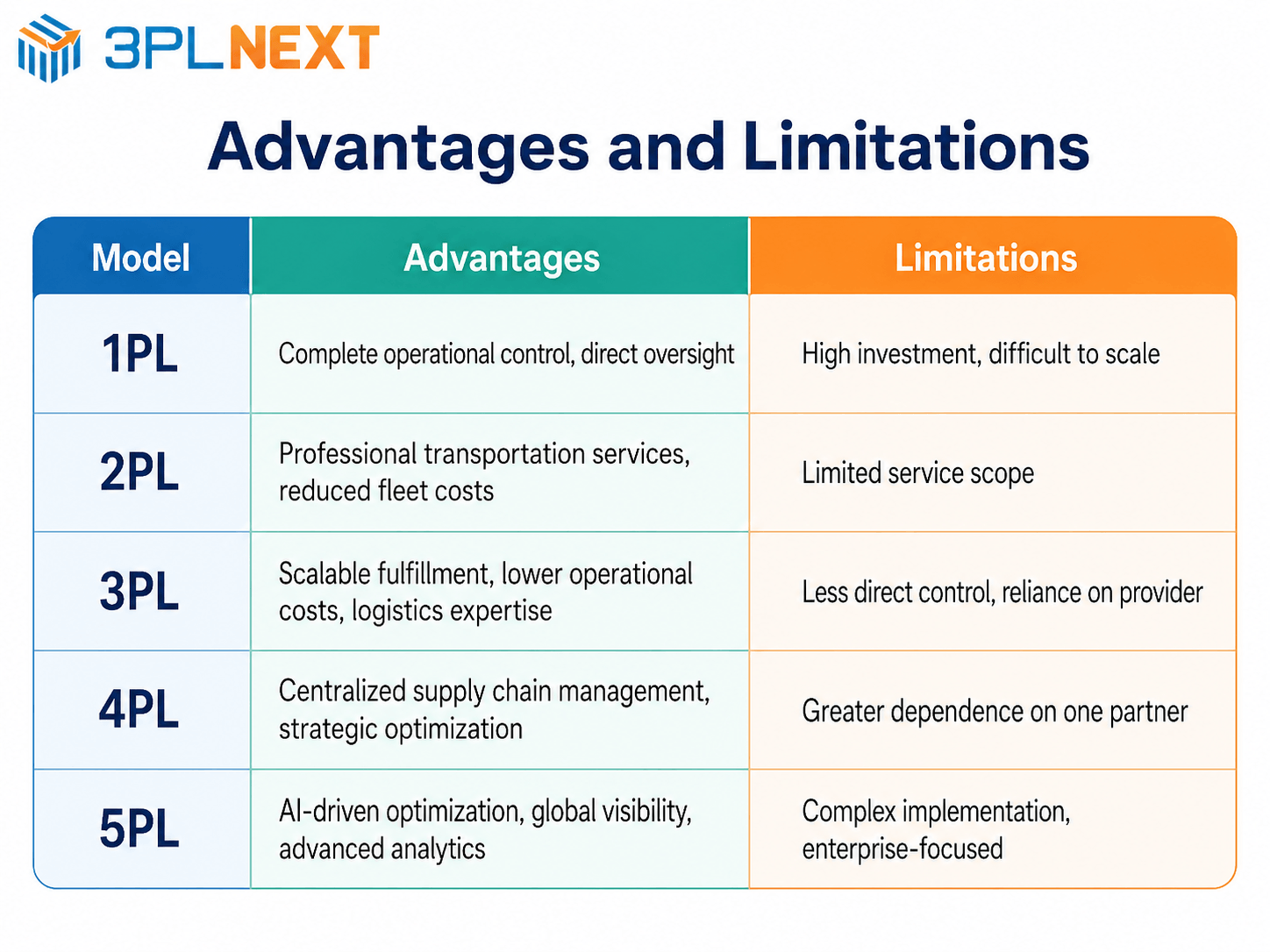
The table below shows how logistics outsourcing has evolved over time.
3PL vs 4PL vs 5PL: A Detailed Comparison
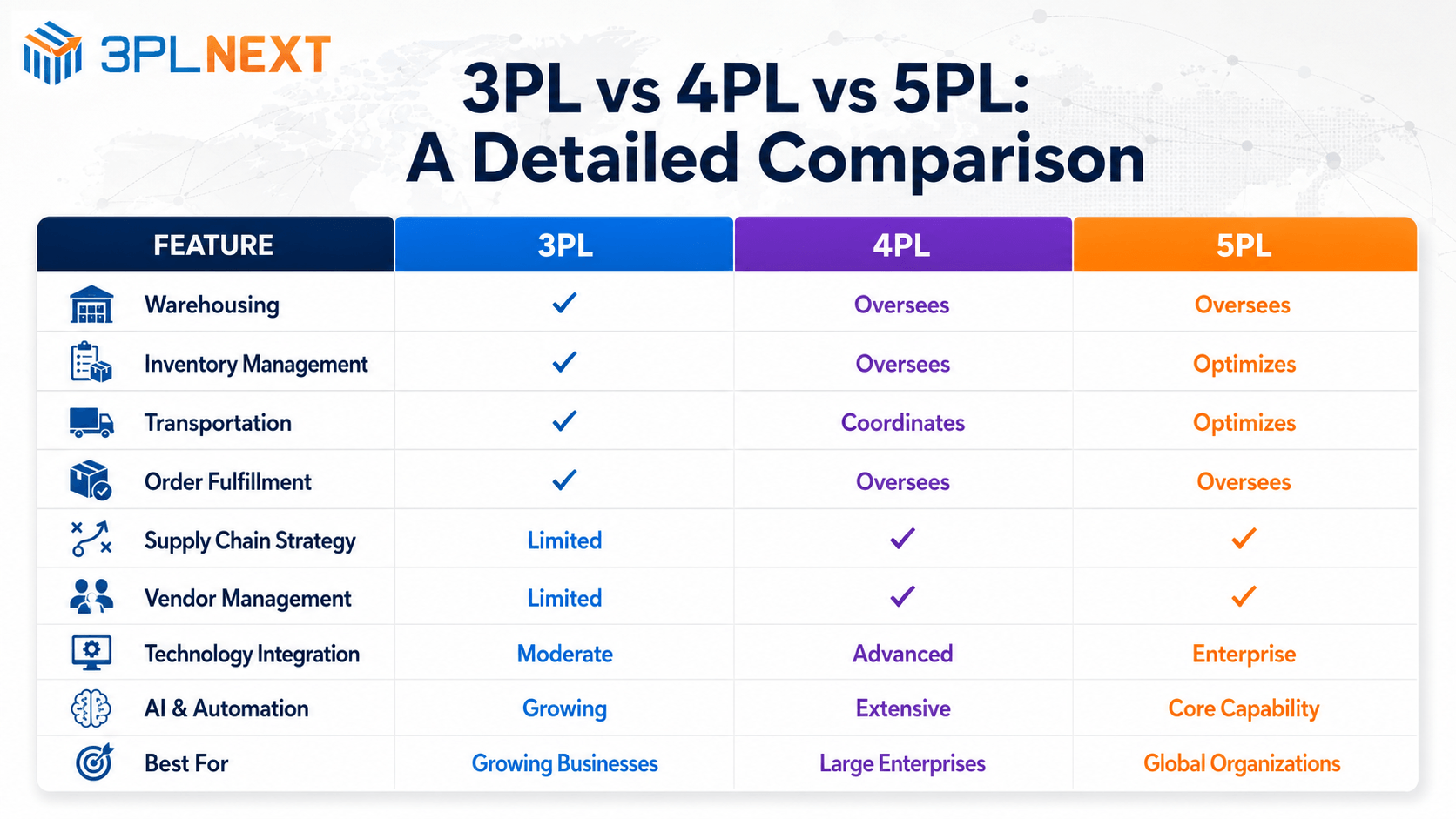
While 1PL and 2PL provide useful context, businesses evaluating logistics outsourcing are typically comparing 3PL, 4PL, and 5PL.
Here’s how they differ.
Which Logistics Model Is Right for Your Business?
Choosing the right logistics model depends on your business size, operational requirements, and future growth plans.
Choose a 3PL if you:
- Need warehousing and order fulfillment services
- Sell through multiple sales channels
- Want to scale without investing in additional warehouse infrastructure
- Require inventory visibility and faster shipping
Choose a 4PL if you:
- Work with multiple logistics providers
- Need end-to-end supply chain coordination
- Want strategic oversight instead of managing vendors internally
- Operate across multiple regions
Choose a 5PL if you:
- Operate globally
- Require AI-driven supply chain optimization
- Manage complex international logistics networks
- Need advanced analytics and automation
The Role of Technology in Modern Logistics
Regardless of whether a business works with a 3PL, 4PL, or 5PL provider, technology has become the backbone of efficient logistics operations. Today’s supply chains demand real-time visibility, faster fulfillment, accurate inventory tracking, and seamless communication between warehouses, carriers, suppliers, and customers.
To meet these expectations, logistics providers increasingly rely on digital solutions such as:
- Cloud-based Warehouse Management Systems (WMS)
- Transportation Management Systems (TMS)
- Barcode and RFID scanning
- Artificial Intelligence (AI)
- Predictive analytics
- Automation and robotics
- API integrations with ERP, accounting, and eCommerce platforms
These technologies help reduce manual work, improve operational accuracy, and enable businesses to make faster, data-driven decisions.
Why Warehouse Management Systems Are Essential for 3PL Providers
For Third-Party Logistics providers, a Warehouse Management System (WMS) is the operational backbone of the warehouse. It centralizes warehouse activities, streamlines workflows, and provides real-time visibility into inventory and order fulfillment.
A modern cloud-based WMS helps logistics providers:
- Track inventory across one or multiple warehouse locations
- Improve receiving and putaway processes
- Optimize picking and packing workflows
- Support barcode and mobile scanning
- Manage lot, batch, and serial numbers
- Automate replenishment
- Process returns efficiently
- Integrate with shipping carriers and eCommerce platforms
- Generate warehouse performance reports
- Manage multiple clients from a single platform
For businesses evaluating a 3PL provider, it’s worth asking what warehouse technology they use. Providers equipped with modern WMS solutions are generally better positioned to deliver accurate inventory management, faster fulfillment, and greater operational visibility.
How AI Is Shaping the Future of Logistics
Artificial Intelligence is transforming logistics by helping businesses analyze operational data, identify trends, and make smarter decisions.
Rather than replacing warehouse teams, AI supports them by improving planning and reducing repetitive manual tasks.
Some common applications of AI in logistics include:
Demand Forecasting
AI analyzes historical sales data and seasonal trends to predict future inventory requirements, helping businesses reduce stockouts and excess inventory.
Warehouse Performance Analytics
AI-powered analytics can identify:
- Top-performing SKUs
- Slow-moving inventory
- Warehouse utilization trends
- Order fulfillment performance
- Labor productivity
These insights help warehouse managers optimize operations and make informed decisions.
Inventory Optimization
AI helps maintain optimal inventory levels by identifying replenishment needs before shortages occur, reducing both overstocking and carrying costs.
Smarter Decision-Making
Instead of manually reviewing reports, warehouse managers can use AI-powered insights to quickly answer operational questions and identify opportunities for improvement.
As AI technology continues to evolve, it will play an increasingly important role in creating more agile, efficient, and resilient supply chains.
Choosing a Technology-Driven Logistics Partner
When evaluating a logistics provider, operational capabilities are just as important as warehouse space or transportation networks.
Consider asking potential providers questions such as:
- Do you use a modern Warehouse Management System?
- Can I access real-time inventory and order information?
- Do you support barcode scanning and mobile warehouse operations?
- Which eCommerce platforms and shipping carriers do you integrate with?
- Can your system scale as my business grows?
- What reporting and analytics are available?
- How do you maintain inventory accuracy?
Providers that invest in modern warehouse technology are often better equipped to support growing businesses and adapt to changing supply chain demands.
Frequently Asked Questions
What is the difference between a 3PL and a 4PL?
A 3PL manages logistics operations such as warehousing, inventory storage, order fulfillment, and shipping. A 4PL oversees the entire supply chain by coordinating multiple logistics providers, vendors, and transportation partners while focusing on strategic optimization.
What is the difference between a 4PL and a 5PL?
A 4PL manages and coordinates a company’s supply chain, while a 5PL goes a step further by using advanced technologies such as AI, automation, and predictive analytics to optimize multiple supply chains across different organizations.
Which logistics model is best for eCommerce businesses?
For most growing eCommerce businesses, a 3PL offers the ideal balance of scalability, cost efficiency, and operational support. It enables businesses to outsource warehousing and fulfillment while focusing on sales, customer experience, and growth.
Can a business transition from a 3PL to a 4PL?
Yes. As operations become more complex and involve multiple logistics providers, many businesses transition from a 3PL to a 4PL model to gain greater strategic oversight and supply chain coordination.
Why is a Warehouse Management System important for 3PL providers?
A Warehouse Management System helps 3PL providers improve inventory accuracy, streamline warehouse operations, optimize picking and packing, automate workflows, and provide customers with real-time visibility into inventory and order status.

Leave a Reply